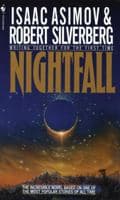
A sci-fi classic from the master of space fiction. Iaac Asimov put together a book of his favorite short stories. If you are a sci-fi fan, you must own this book! This description may be from another edition of this product.
Born Isaak Yudovich Ozimov in Russia in about 1920, Isaac Asimov is well known for his science fiction and popular science books. He also wrote mysteries, fantasy, and works on Shakespeare, mathematics, and the Bible. Asimov's family emigrated to the United States when he was a toddler, and he became a naturalized American citizen in 1928. Asimov attended public schools in Brooklyn, New York, graduating at 15 from high school. He attended college at two different branches of Columbia University, graduating with a BS degree in chemistry in 1939. Continuing at Columbia, Asimov completed an MA in chemistry in 1941 and a PhD in biochemistry in 1948. He interrupted his studies to work at the Philadelphia Navy Yard's Experimental Air Station and to serve in the U.S. Army after the war ended. Once he completed his doctorate, he joined the faculty at Boston University School of Medicine where he remained even when his writing income surpassed his academic salary. Asimov wrote or edited more than 500 books and hundreds of short stories. Widely considered a science fiction master, he was the author of three major series, Foundation, Galactic Empire, and Robot. His story Nightfall was voted as the best science fiction story of all time by the Science Fiction Writers of America in 1964. An asteroid, a crater on Mars, a literary award, and a high school in Brooklyn are all named in his honor. He won many awards for particular works along with lifetime achievement awards and fourteen honorary doctorates. Asimov died in 1992.
This is a collection of excerpts, extracts, stories and essays taken from Asimov's first 100 books. Apparently he liked to keep count, like a score, as to how many he had published. The majority is non-fiction, and he does point out he was mostly a non-fiction writer, given the rather astonishing range of subjects he wrote books on for kids to adults, from astronomy to religion. One amusing magazine anecdote, after Esquire refused a story he sent them, basically saying their readers were too uneducated to understand it: "I didn't care. I sent it to Fred Pohl, and he took it for his magazine, If. At least, he took it after a little hesitation. He wrote and said that he would like to cut it in half. (He must have had som eobscure reason for that, but who knows what evil lurks in the hearts of editors.) I wrote back, rather humbly, and said I didn't want to sound like Harlan Ellison (a tremendously talented science-fiction writer who is known throughout the field for his trigger-temper and his refusal to take any lip from any editor), but the story ha dto be publihsed in toto for two reasons: (1) It was a satire on The Double Hleix and the satirical point would be killed if it were cut, and (2) it was the only story I had ever written in which I wrote as ribaldly as I talk, and I might never do it again, so I didn't want to lose one precious paragraph. Consequently, said I, if he felt he had to cut it, would he return the manuscript instead? Whereupon Fred answered and said he would print it in full and I did, too, sound like Harlan Ellison. Which was a terrible thing to say." Opus 100 : from The Callistan Menace - Isaac Asimov Opus 100 : from Lucky Starr and the Moons of Jupiter - Isaac Asimov Opus 100 : from Lucky Starr and the Oceans of Venus - Isaac Asimov Opus 100 : from The Martian Way - Isaac Asimov Opus 100 : from Strange Playfellow - Isaac Asimov Opus 100 : from Liar! - Isaac Asimov Opus 100 : from Runaround - Isaac Asimov Opus 100 : from I Robot - Isaac Asimov Opus 100 : The Last Question - Isaac Asimov Opus 100 : The Feeling of Power - Isaac Asimov Opus 100 : from Supernutron - Isaac Asimov Opus 100 : Thiotimoline and the Space Age - Isaac Asimov Opus 100 : from The Dead Hand - Isaac Asimov Opus 100 : Dreamworld - Isaac Asimov Opus 100 : The Holmes-Ginsbook Device - Isaac Asimov Jupiter keeps pulling me back in. 3 out of 5 Ganymede eclipse. 3 out of 5 Big jellyfish. 3 out of 5 Water inspiration. 3 out of 5 Made to be good at it. 3 out of 5 Robot dilemma. 3 out of 5 Laws enunciated. 3 out of 5 The Three Laws. 3.5 out of 5 Immortal humans breed too fast for the universe. 4 out of 5 Computer people consequences. 3 out of 5 Old school atomics. 3 out of 5 Chemistry before it happens. 3 out of 5 Sick of sick. 3 out of 5 Food of the godawful puns. 3.5 out of 5 Smoking breakthrough. 3 out of 5 3.5 out of 5
0
★★★★★
Engaging summary of Isaac Asimov's first 99 books
By Thriftbooks.com User, December 10, 2001
Certainly there is no one who can match the breadth of Asimov's writings, although there are a few who can match the volume. The man truly can be described as "the human writing machine." This is a book about books, being a summary of the first 99 that he wrote. To be more precise, it is a collection of excerpts from several of those books interspersed with Asimov's personal commentary concerning his writing and how he came to write about that particular topic. I found the commentary to be more interesting than the excerpts. He writes in a very personal style that seems to be directed to you as you read it. His tactics and even occasional humility, a rare thing for Asimov and something he readily admits, gives you a great deal of insight into how he could be so prolific and broad. He sums up his career very well when he admits that the only thing that he is expert at is in sounding like an expert. I confess that I learned more science from reading Asimov's books than I did in satisfying the requirements for two majors in areas of science. He writes very well, making the complex understandable. If you are unfamiliar with his work, then this book is a good place to begin. If you have read nearly all of his over 300 books, then you can still read this for pleasure, something I just did for the third time.
1
★★★★★
Compulsory reading for anyone interested in Sci or Fi
By Thriftbooks.com User, January 8, 2001
In this book Mr. Asimov reviews his first 100 books. He presents a chapter from each one with some comments about the way the book was written, the characters (if it's a fiction story) or the research if it's a Science book. Compulsory reading for anyone interested in Science and/or Fiction.