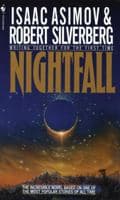
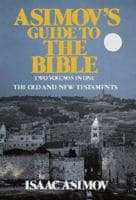
Born Isaak Yudovich Ozimov in Russia in about 1920, Isaac Asimov is well known for his science fiction and popular science books. He also wrote mysteries, fantasy, and works on Shakespeare, mathematics, and the Bible. Asimov's family emigrated to the United States when he was a toddler, and he became a naturalized American citizen in 1928. Asimov attended public schools in Brooklyn, New York, graduating at 15 from high school. He attended college at two different branches of Columbia University, graduating with a BS degree in chemistry in 1939. Continuing at Columbia, Asimov completed an MA in chemistry in 1941 and a PhD in biochemistry in 1948. He interrupted his studies to work at the Philadelphia Navy Yard's Experimental Air Station and to serve in the U.S. Army after the war ended. Once he completed his doctorate, he joined the faculty at Boston University School of Medicine where he remained even when his writing income surpassed his academic salary. Asimov wrote or edited more than 500 books and hundreds of short stories. Widely considered a science fiction master, he was the author of three major series, Foundation, Galactic Empire, and Robot. His story Nightfall was voted as the best science fiction story of all time by the Science Fiction Writers of America in 1964. An asteroid, a crater on Mars, a literary award, and a high school in Brooklyn are all named in his honor. He won many awards for particular works along with lifetime achievement awards and fourteen honorary doctorates. Asimov died in 1992.
Among the major problems which Asimov felt were confronting Mankind were many of the environmental issues which confront us today. Asimov was especially concerned with overpopulation which in subsequent years became the major concern of those concerned with the human future. However at this point in the midst of what Ben Wattenberg has called ' the demographic dearth' with drastically declining birth- rates especially in Japan, Europe and the developed world, but also elswhere there are different kinds of demographic questions dominating the agenda. One of thsoe of course is the gender imbalance produced in India and China through the ' technological gift' of enabling parents to select the sex of their child. In general Asimov tends to be optimistic about scientific developments. And in certain contexts he has argued that as ' science and technology' are the only real bringers of change, they are far more significant than traditional humanities and social - sciences. Asimov as a champion of science and 'science- fiction' which for him are the source of the true original ideas in our world is perhaps a bit less critical of certain kinds of possibly destructive scientific work than he might be. Asimov was only 'human' and could not of course foresee fully our biotechnologically dominant world, but he approached every subject with a maximum of study, real intelligence and rationality. In all his books he is a great teacher. And this one is no exception.