


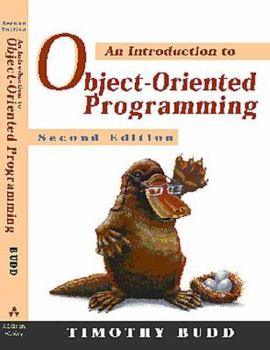
An Introduction to Object-Oriented Programming

Select Format
Select Condition 
Book Overview
Timothy Budd lays out the principles of object-oriented programming, illustrating object-oriented principles. The reader learns the basic concepts of object-oriented programming as well as the... This description may be from another edition of this product.
Format:Hardcover
Language:English
ISBN:0201824191
ISBN13:9780201824193
Release Date:January 1
Publisher:Addison-Wesley Longman, Incorporated
Length:452 Pages
Weight:1.71 lbs.
Dimensions:9.8" x 1.0" x 6.8"
Customer Reviews
5 ratings
Great Introduction to OOP
Published by Thriftbooks.com User , 23 years ago
I've read a number of introductions to object-oriented design and programming. This one is the best all-around introduction that I have seen. It starts in the real world, with a discussion of how one plans and organizes a task (sending flowers to a significant other) that requires more than a single person to get done. That's a pleasant change from texts that begin with Dauntingly Dry Definitions ("encapsulation", "inheritance", and my favorite, "polymorphism"). To the author's credit, he avoids launching into inheritance until Chapter 8, by which time he has laid enough groundwork to reduce the concept to common sense. Other concepts are presented in a similar manner.Note that this book is a survey book, not an in-depth programming manual. You won't learn C++ or Delphi, or any of the other half-dozen languages used for the book's examples. And the book focuses on concepts, rather than implementation. you won't learn how to implement a Singleton pattern in C#, although you will learn what it is and why it is useful. Finally, the book assumes familiarity with traditional, procedural programming. This is not a Programming 101 text.I would recommend this book enthusiastically as a starting point for anyone making the transition from traditional programming to OOP. If you are moving to the DotNet platform, I have created a list ("So you'd like to ... Transition to DotNet") with some other recommended texts.
Sets the proper foundation
Published by Thriftbooks.com User , 24 years ago
I've been using classes more as a means of organizing and improving the maintainability, understanding of various applications I've built over the past 3 years (VB). As I am about to develop solutions using the .NET platform (C#, VB.NET), I thought it would do me good to formalize my understanding of OOP/OOD. After reading this text (3rd Edition), I not only formalized my understanding, but was able to see OOP as clearly as I could structured programming (Code Complete). In my opinion, all should use this as the first book before trying to participate/apply J2EE or Microsoft.NET as it will allow you "properly" communicate, design and code systems from abstraction to detail.
Great as a first book on object-oriented programming
Published by Thriftbooks.com User , 25 years ago
I really enjoyed this book. The author covers all the important oo concepts in several languages. This allows you to get an excellent perspective on each concept without being distracted by each language's implemention of that concept. I also appreciated the writing skills of the author. He was always clear and precise. A lot of information is packed into a relatively slim volume. Of several introductory oo books I've recently read, this one easily tops my list.
so what is the OOP?
Published by Thriftbooks.com User , 26 years ago
I bought this book recently and have not finished yet. But I can say that this book is the best for the programmers who have some experience with object oriented programming using languages such as C++/Object Pascal, Java. This book does not teach just programming but the concept and design that are more important. so read this then you can do the real OOP and if someone asks to you that "so what is the OOP?", you can answer the essence.
Very good introduction to a beginer in OO
Published by Thriftbooks.com User , 27 years ago
This book really shows you how to think in object oriented way, rather than how to simply code using oo techniques. This book is definitely a good starting point for a programmer who wants to think in object oriented way.
Copyright © 2026 Thriftbooks.com
Terms of Use | Privacy Policy | Do Not Sell/Share My Personal Information | Cookie Policy | Cookie Preferences | Accessibility Statement
ThriftBooks ® and the ThriftBooks ® logo are registered trademarks of Thrift Books Global, LLC
ThriftBooks ® and the ThriftBooks ® logo are registered trademarks of Thrift Books Global, LLC
