


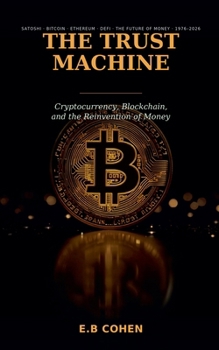
The Trust Machine

On the last day of October 2008, with the world's banks in flames, a stranger calling himself Satoshi Nakamoto posted nine pages to an obscure mailing list. He proposed something everyone believed impossible: money with no bank, no company, no government behind it - a ledger kept by no one and everyone, secured not by trust but by mathematics. He built it, watched it grow, and then vanished forever, leaving behind a fortune he never spent and a mystery no one has solved.
In The Trust Machine, E.B Cohen tells the whole astonishing story - from the 1970s cryptographers and 1990s cypherpunks who made it thinkable, through the genesis block and the ten-thousand-bitcoin pizza, to the booms and catastrophic busts, the founders and the fraudsters, and the strange final act in which a rebellion against banks became an asset held by the largest firm on Wall Street and the government of the United States.
Along the way, Cohen explains the technology itself - hashing, keys, mining, proof-of-stake, smart contracts - from first principles, with an everyday clarity that assumes no prior knowledge, while telling a human story on every page. Here are the Byzantine generals and the double-spending problem; Silk Road and Mt. Gox; the boy who built Ethereum; the collapse of Terra and the fall of FTX; the ETFs, the regulators, and the trillion-dollar question of what any of it is really worth.
Even-handed, gripping, and genuinely explanatory, this is the one complete account of the most divisive invention in modern finance - the technology that set out to replace trust, and the very human story of everyone who believed in it, or tried to break it, or simply wondered whether it could possibly be real.
Customer Reviews
ThriftBooks ® and the ThriftBooks ® logo are registered trademarks of Thrift Books Global, LLC
