


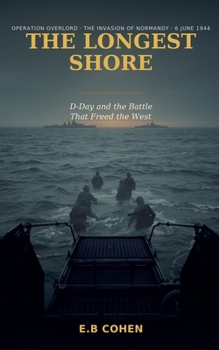
The Longest Shore

Before dawn on 6 June 1944, an armada of nearly seven thousand ships crept toward a sleeping coast in occupied France. In the darkness above, thousands of paratroopers fell from the sky into hedgerow and flooded field. By nightfall, a hundred and fifty thousand men had forced their way onto five code-named beaches - Utah, Omaha, Gold, Juno, Sword - and the liberation of Western Europe had begun.
But the day itself was only the hinge of a far larger story. In The Longest Shore, E.B Cohen tells the whole of it, from the beaches back to the strategy rooms and forward into the terrible summer that followed. Here is the secret war of deception that convinced Hitler the blow would fall elsewhere; the phantom army of inflatable tanks and the double agent called Garbo; the engineering wizardry of harbours that were built in England and floated across a sea; the meteorologist whose forecast held the fate of the invasion in a single sentence; and the one man, Dwight Eisenhower, who had to say the word that could not be taken back.
And here, above all, are the human beings - the paratrooper snagged on a church steeple, the Rangers clawing up the cliff at Pointe du Hoc, the men cut down in the surf at Omaha, the Norman farmers caught between the armies, the German gunner watching a fleet materialize out of the mist. From the first glider that touched down at Pegasus Bridge to the day Paris rang its bells again, this is the complete, gripping, and deeply human story of how the free world came ashore and would not be pushed back into the sea.
Customer Reviews
ThriftBooks ® and the ThriftBooks ® logo are registered trademarks of Thrift Books Global, LLC
