Skip to content
ISBN: 158510308X
ISBN13: 9781585103089

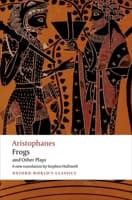
Frogs

$8.09List Price: $10.95
Save $2.86!
ISBN: 158510308X
ISBN13: 9781585103089
Formats

Conditions

A read copy, but remains in excellent condition.

Formats

Conditions

A read copy, but remains in excellent condition.

See all 202 editionsfrom $5.59

Book Overview

Aristophanes' sophisticated comedy on the style and role of the plays of the modern Euripides vis a vis the traditional Aeschylus, contains his most brilliant parodies. These are asset in the fantastic and farcical context of Dionysus, disguised as Herakles, with his memorably cheeky slave Xanthias, descending into Hades to resurrect Euripides but returning instead with Aeschylus.

Stanford's edition of Frogs includes introduction, Greek text and commentary. It contains a substantial introduction on the play's background, and interpretation. The commentary is detailed on matters of language, metre and content, and a bibliography of further reading is provided.

This description may be from another edition of this product.
Format:
Paperback
Language:
English
ISBN:
158510308X
ISBN13:
9781585103089
Release Date:
April 2008
Publisher:
Hackett Publishing Company, Incorporated
Length:
112 Pages
Weight:
0.44 lbs.
Dimensions:
0.4″ × 5.5″ × 8.5″
DramaHistoryLiterary Criticism & CollectionsLiterature & Fiction

More by Aristophanes

Customer Reviews

1 customer rating | 1 review
Write a Review

Aristophanes's farcical attempt at dramatic criticism

On the one hand Aristophanes's comedy "The Frogs" is a farce, but it is of more interest because it presents the earliest known example of dramatic criticism. Presented in 405 B.C., the play tells of how Dionysus, the god of drama, had to go to Hades to fetch back Euripides, who died the previous year, because Athens no longer had any great tragic poets left. The first part of the comedy involves Dionysus, who has disguised himself as Heracles, and his slave Xanthias on their way to Hades and features several interesting songs by the chorus of blessed mystics and the chorus of frogs. However, the high point of the comedy is the contest between Euripides and Aeschylus. Each of the two great tragic poets denounces the other and quotes lines from their own works to prove their superiority. We discover that Euripides writes about vulgar themes, corrupts manners, debases music and has prosaic diction. In contrast, Aeschylus finds obscure titles and is guilty of turgid prose. In the end Dionysus finds that artistic standards of judgment are useless and turns to a political solution. This makes sense since the problem facing Athens is a political one: what to do about the tyrant Alcibiades. What is most interesting is the implicit belief that the tragic poets had a social responsibility towards the audiences of their dramas. "Frogs," in addition to being one of the better comedies by Aristophanes, is also of interest because it contains the only fragments from several tragedies by Euripides and Aeschylus that have been long lost to us. As always, I urge that if you are studying Greek plays, whether the comedies of Aristophanes or the tragedies by those other more serious fellows, it is important to understand the particular structure of these plays and the various dramatic conventions of the Greek theater. This involves not only the distinction between episodes and stasimons (scenes and songs), but elements like the "agon" (a formal debate on the crucial issue of the play), and the "parabasis" (in which the Chorus partially abandons its dramatic role and addresses the audience directly).

0