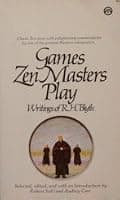
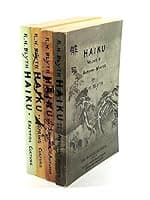
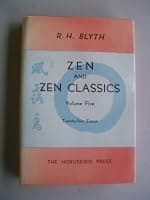
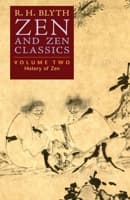
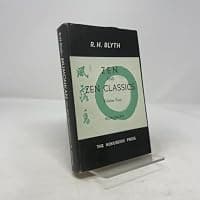
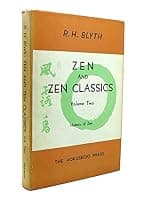
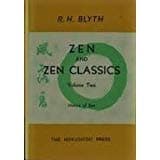
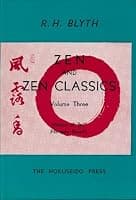
This work is a fascinating introduction to Zen and to the self-enlightenment and inner reason that has been a driving force in the history of Japan. In the volumes comprising Zen and Zen Classics, Reginald Horace Blyth (1898-1964) devotes himself to conveying the true character and attitude of Zen, leading the reader to a heightened sense of inner self and to an awakening of awareness of the surrounding universe and one's relationship to it.
In Volume One, after discussing "what is Zen?" (and what isn't), Blyth sketches a history of Zen from 1000 B.C. to A.D. 715, the year of the death of the Sixth patriarch, Huineng. With a historical background thus established, he next provides translations and commentary on some of the most important and basic Zen literature. For the Zen initiate, then, this book provides an excellent place to begin. For the practitioner, further meaningful revelations await.
The other volumes of Blyth are very hard to get. The collection of writings and extracts does a good job of condensing the essence of those volumes. The flavor of the writings is what I would call "Zen existentialism". I read the book from cover to cover with rapt attention about 25 years ago. What I got from the writings was about accepting myself and life as it is, meeting it directly, and cutting through every kind of theory to be with what really is. The gift of Zen is that, while emerging from the very heart of what Buddha taught, cuts through even the words of the Buddha to what he saw and even more important than what he saw is what we actually see, right here and right now.
0
★★★★☆
Frederick Franck, editor of R. H.Blyth's Great Works
By Thriftbooks.com User, March 26, 2000
Franck's "Zen and Zen Classics" is his editing of the writings of R. H. Blyth on Ch'an/Zen, which are otherwise out of print. It is a great book, specially since it contains the only in-print works of Blyth, who, Franck says, is the indispensible interpreter of Zen for the western mind, and that Blyth is the ever-open eye. This is a great book, and can lead to even greater ones by Blyth---if onlt they would print more.
0
★★★★☆
Frederick Franck, editor of R. H.Blyth's Great Works
By Thriftbooks.com User, March 26, 2000
Franck's "Zen and Zen Classics" is his editing of the writings of R. H. Blyth on Ch'an/Zen, which are otherwise out of print. It is a great book, specially since it contains the only in-print works of Blyth, who Franck says is the indispensible interpreter of Zen for the western mind, and that Blyth is the ever-open eye. This is a great book, and can lead to even greater ones by Blyt---if onlt they would print more.