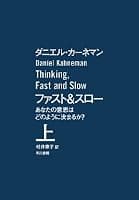
Thinking, Fast and Slow
Conditions
An apparently unread copy in perfect condition.
Formats
Conditions
An apparently unread copy in perfect condition.
Conditions
An apparently unread copy in perfect condition.
Formats
Conditions
An apparently unread copy in perfect condition.
Major New York Times bestseller
Over two million copies sold
Selected by the New York Times Book Review as one of the ten best books of 2011
Selected by The Wall Street Journal as one of the best nonfiction books of 2011
2013 Presidential Medal of Freedom Recipient
Daniel Kahneman's work with Amos Tversky is the subject of Michael Lewis's best-selling The Undoing Project: A Friendship That Changed Our Minds
Daniel Kahneman is Eugene Higgins Professor of Psychology Emeritus at Princeton University and Professor of Psychology and Public Affairs Emeritus at Princeton's Woodrow Wilson School of Public and International Affairs. He received the 2002 Nobel Prize in Economic Sciences for his pioneering work with Amos Tversky on decision-making.
This book came to me highly recommended by a credible scientist. Thus setting up expectations. But, the book is primarily one old man's reminiscing about his academic work in the 1960's-1970's when academic psycho-babble was all the rage. A time when pop-psychologists (many of whom were legitimate psychologists) revealed what they thought were iconoclastic profound insights; but in reality they were insights that any wizened Iowa corn farmer, New York street huckster or Los Angeles advertising executive knew since they were 12 years old. Quickly the book becomes a search; looking for what had made the book so highly recommended. But in the end, each chapter of the book is like rummaging around garage sales in search of that one special find – maybe a stunning Capodimonte from the 1750's going for five bucks, or a 100 carat diamond in a box of pretty rocks going for a quarter each. In the end, one has rummaged around a lot of dusty old books, chipped mugs, outdated video games and a few broken bicycles, and come away with one pretty quartz crystal. I was particularly disappointed that the book had no references and no citations. Until I got to the end when I was astonished to discover there were 418 references – all numbered, but NOT A SINGLE FOOTNOTE in the text so one can align the given footnote at the end of the book to a particular location in the text. I suppose if someone was an early, socially awkward, sophomoric teenager who was really "into" pop-psychology this would be a great introduction on how normal people think. Otherwise, a good editor could easily reduce this 500 page doorstop to a 20 page pamphlet. You should not be surprised if you find my copy in your neighbor's next garage sale.
Great book that you can apply to everyday life. Look at your own biases and the biases of others and how it influences your thinking. A little dry but if you apply it appropriately it’s eye opening.
Published by Ashly Moore SheldonDecember 17, 2023
Our newest survey with OnePoll asked 2,000 U.S. adults how they feel about the self-help genre. And what we learned gave us a whole new way of looking at things.
Published by ThriftBooks TeamJanuary 26, 2022
Are you looking for an extra-special birthday gift? Try getting someone a book based on their astrological sign! We have some great ideas for this beloved air sign with Aquarius season in the air.
Published by Beth ClarkJanuary 7, 2019
Aside from the obvious self-help category, books make life better in so many ways that it's hard to imagine existing without them...so we won'! Thankfully, we don't have to. Here are just some of the ways that reading books is as essential as, oh, breathing.