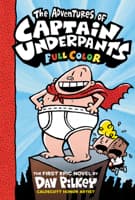
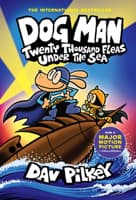
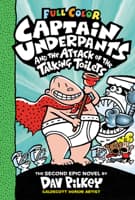
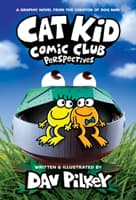
When Dav Pilkey was a kid, his teachers thought he was disruptive, "behaviorally challenged," and in serious need of a major attitude adjustment. When he wasn't writing sentences in the detention room, he could usually be found sitting at his private desk out in the hallway. There he spent his time writing and drawing his own original comic books about a superhro named Captain Underpants. Dav's teachers told him, "You'd better straighten up, young man, because you can't spend the rest of your life making silly books." Dav was not a very good listener! But seriously... Dav Pilkey has written and illustrated several popular award-winning books for children. The Adventures of Captain Underpants, which has nearly one million copies in print, was an American Bookseller Pick of the Lists and a Publishers Weekly "Cuffie" Award winner for the Funniest Book of the Year; Dog Breath was awarded the California Young Reader Medal; The Paperboy was chosen as a Caldecott Honor Book. Mr. Pilkey also illustrated the IRA-CBC Children's Choice Award-winning Dumb Bunnies books. Dav Pilkey and his dog live in Oregon.
I read this book to my son at least 2x/week for bedtime and now he won't partvwith the book at all a
By Lynn P., November 18, 2024
I love how simple & innocent the book is. The boy shoes his dedication to his jib and finishing it while his dog shows him loyalty by delivering papers with him. We love it.
1
★★★★★
Serindipulous Book
By Thriftbooks.com User, April 23, 2001
The Paperboy was written and illustrated by Dav Pilkey. This was a fun-to-read, lighthearted book that relayed a very vivid lesson of maturity and hard work. In the story, a boy and his dog get up early every morning and deliver papers. The paperboy was a very responsible young man who loved his job. The bright and happy illustrations played a key role in letting the reader know how happy the boy and his dog were. In this story, the author uses various forms of symbolism to portray the paperboy as being a very mature and hard-working young man. One of the first very obvious symbolic representations was the young boy's receding hairline. While this doesn't necessarily mean he is mature, it is a trait displayed by men who are generally much older, wiser, and more mature. In many foreign countries, older men, who usually have little or no hair, are more respected and thought to be wise and knowledgeable. I think the author was probably using this common knowledge to help relay his message of maturity. Another key symbolic representation is the way the boy cares for the dog as his own child. He takes him everywhere, feeds him, and watches over him. These are all characteristics of a mature adult who has accepted the responsibility of being a parent. Lastly, the fact that the boy leaves his warm bed very early on a cold Saturday morning while everyone else is still asleep, speaks wonders of his dedication and level of maturity. In the book, the paperboy never hesitates when his alarm goes off. He knows he has a job to do, and he does it. Even the boy's dog, who he has cared for and taught behavioral patterns, is eager to start the early day. In this book, the paperboy was clearly a responsible and dedicated young man. The various forms of symbolism that the author used were a very effective means of relaying this message.