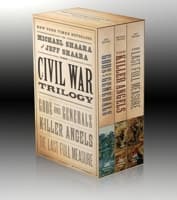
The Killer Angels: The Classic Novel of the Civil War
(Book #2 in the The Civil War Trilogy Series)
Conditions
A read copy, but remains in excellent condition.
Formats
Conditions
A read copy, but remains in excellent condition.
(Book #2 in the The Civil War Trilogy Series)
Conditions
A read copy, but remains in excellent condition.
Formats
Conditions
A read copy, but remains in excellent condition.
This should be a must read for any history/civil war buff. This book goes beyond the battle and focuses far more on the human aspect of war and the consequences of decisions. It is interesting to see from multiple figures on both sides. I just received Gods & Generals and can't wait to get started
It can get very easy to view history in 2D, but this book puts you right into the thick of it. You actually get to glimpse into the minds and feelings of the players of the Battle of Gettysburg, and really start to see them and living, breathing people.
The dehumanizing nature of war is perfectly captured by Michael Shaara’s book titled “The killer angles”. Stories of war about leaders and losses.
This brilliant book explains clearly why Stuart, Ewell and Lee combined to lose Gettysburg and how Longstreet wanted desperately to override their mistakes Chamberlain over emphasized but he lived long enough to tell his story
Originally published in 1974, Killer Angels, by Michael Shaara, won the Pulitzer Prize as historical fiction about the Battle of Gettysburg. About a quarter of a century later, and following his death, his son, Jeff, an accomplished writer in his own right, was convinced to write both a prequel (Gods and Generals) and a sequel (Last Full Measure) creating perhaps the greatest trilogy of the Civil War’s Eastern Theater in existence, and Killer Angels started it. A beautifully written masterpiece, Killer Angels places the reader in the middle of the story and discusses the campaign through the eyes of its major participants. When viewed from a Southern vantage point, Michael does an excellent job of depicting their point of view. The same is true when writing from the Northern character’s perspective. This makes reading this novel truly a pleasure. Few writers are so talented that they can make a long, boring forced march described in such a way that the reader can’t put the book down. But I was in that formation, exhausted, sweating, putting one foot in front of the other, marching to an uncertain fate. This is what historical fiction should be. And it stands the test of time. It is just as good now as when I first read it almost 50 years ago.