


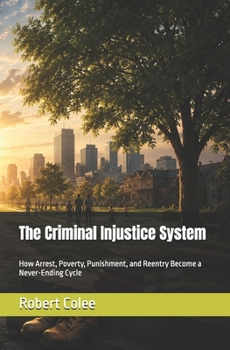
The Criminal Injustice System: How Arrest, Poverty, Punishment, and Reentry Become a Never-Ending Cycle
No Customer Reviews

When the Punishment Begins Before the Verdict
The American criminal justice system is founded upon principles that sound both simple and noble: a person is presumed innocent, government power is limited by law, an accused person has the right to counsel, unreasonable searches are forbidden, and no person may be deprived of liberty or property without due process.
Yet the lived experience of the system can be radically different.
For many people, the most destructive punishment does not begin with a conviction. It begins with the flashing blue lights in the rearview mirror.
A driver may be traveling to work, returning home, transporting medication, or conducting ordinary business when an encounter begins over a traffic violation, a damaged light, an expired registration, or an officer's suspicion. Within minutes, the driver may be standing beside the road, handcuffed, searched, questioned, and taken to jail.
The vehicle may be towed. The driver may not have money to retrieve it. Storage fees accumulate every day.
The person may miss work and be fired. Rent goes unpaid. Children are left without transportation. Medication may be unavailable in jail. A frightened family may spend its savings on a bondsman or attorney. None of this requires a conviction.
A charge alone can begin dismantling a life.
Georgia provides a particularly important setting for examining these problems. In 2024, Georgia expanded mandatory cash-bail requirements to 30 additional offenses, including numerous misdemeanors. A constitutional challenge filed in 2025 argued that the law can detain people who present little danger simply because they cannot afford their release. Supporters contend that stronger bail requirements promote accountability and court appearances; critics argue that they punish poverty and destabilize employment, housing, and families before guilt has been established.
Hall County contains the same institutions found throughout the country: municipal and state courts, a county jail, prosecutors, public defenders, bondsmen, probation officers, treatment providers, towing companies, and agencies responsible for collecting fines and fees. Hall County operates an indigent-defense system and a misdemeanor probation office that accepts payments from people under supervision. These services are lawful parts of county government, but their presence also illustrates how an arrest can place a person into a complicated network of obligations, appointments, payments, and deadlines.
This book will not argue that every police officer is corrupt, that every arrest is false, or that every defendant is innocent. Society needs lawful methods of responding to violence, exploitation, theft, abuse, and dangerous conduct. Victims deserve protection, recognition, restitution, and justice.
But public safety and constitutional liberty are not opposing ideas.
A system becomes unjust when it treats accusation as guilt, poverty as defiance, addiction as moral failure, homelessness as criminal intent, and administrative mistakes as proof that a person refuses to comply.
It becomes especially dangerous when every stage of the process creates another financial interest.
There may be money for the towing company, the bondsman, the jail contractor, the telephone provider, the electronic-monitoring company, the probation provider, the drug-testing laboratory, the court, and the collection agency. Each charge may be authorized by law and justified as necessary. Taken together, however, they can form a machinery that consumes nearly every resource available to an accused person.
Private incarceration adds another layer of concern. Prison contracts containing minimum-occupancy or guaranteed-payment provisions have existed in the United States. Such clauses do not necessarily order police or judges to arrest particular people, but they can require governments to pay for a contracted percentage of prison beds occupied or n...
The American criminal justice system is founded upon principles that sound both simple and noble: a person is presumed innocent, government power is limited by law, an accused person has the right to counsel, unreasonable searches are forbidden, and no person may be deprived of liberty or property without due process.
Yet the lived experience of the system can be radically different.
For many people, the most destructive punishment does not begin with a conviction. It begins with the flashing blue lights in the rearview mirror.
A driver may be traveling to work, returning home, transporting medication, or conducting ordinary business when an encounter begins over a traffic violation, a damaged light, an expired registration, or an officer's suspicion. Within minutes, the driver may be standing beside the road, handcuffed, searched, questioned, and taken to jail.
The vehicle may be towed. The driver may not have money to retrieve it. Storage fees accumulate every day.
The person may miss work and be fired. Rent goes unpaid. Children are left without transportation. Medication may be unavailable in jail. A frightened family may spend its savings on a bondsman or attorney. None of this requires a conviction.
A charge alone can begin dismantling a life.
Georgia provides a particularly important setting for examining these problems. In 2024, Georgia expanded mandatory cash-bail requirements to 30 additional offenses, including numerous misdemeanors. A constitutional challenge filed in 2025 argued that the law can detain people who present little danger simply because they cannot afford their release. Supporters contend that stronger bail requirements promote accountability and court appearances; critics argue that they punish poverty and destabilize employment, housing, and families before guilt has been established.
Hall County contains the same institutions found throughout the country: municipal and state courts, a county jail, prosecutors, public defenders, bondsmen, probation officers, treatment providers, towing companies, and agencies responsible for collecting fines and fees. Hall County operates an indigent-defense system and a misdemeanor probation office that accepts payments from people under supervision. These services are lawful parts of county government, but their presence also illustrates how an arrest can place a person into a complicated network of obligations, appointments, payments, and deadlines.
This book will not argue that every police officer is corrupt, that every arrest is false, or that every defendant is innocent. Society needs lawful methods of responding to violence, exploitation, theft, abuse, and dangerous conduct. Victims deserve protection, recognition, restitution, and justice.
But public safety and constitutional liberty are not opposing ideas.
A system becomes unjust when it treats accusation as guilt, poverty as defiance, addiction as moral failure, homelessness as criminal intent, and administrative mistakes as proof that a person refuses to comply.
It becomes especially dangerous when every stage of the process creates another financial interest.
There may be money for the towing company, the bondsman, the jail contractor, the telephone provider, the electronic-monitoring company, the probation provider, the drug-testing laboratory, the court, and the collection agency. Each charge may be authorized by law and justified as necessary. Taken together, however, they can form a machinery that consumes nearly every resource available to an accused person.
Private incarceration adds another layer of concern. Prison contracts containing minimum-occupancy or guaranteed-payment provisions have existed in the United States. Such clauses do not necessarily order police or judges to arrest particular people, but they can require governments to pay for a contracted percentage of prison beds occupied or n...
Format:Paperback
Language:English
ISBN:B0H9PCTSCL
ISBN13:9798188256449
Release Date:July 2026
Publisher:Independently Published
Length:474 Pages
Weight:1.08 lbs.
Dimensions:0.9" x 5.3" x 8.0"
Customer Reviews
0 rating
Copyright © 2026 Thriftbooks.com
Terms of Use | Privacy Policy | Do Not Sell/Share My Personal Information | Cookie Notice | Cookie Preferences | Accessibility Statement
ThriftBooks ® and the ThriftBooks ® logo are registered trademarks of Thrift Books Global, LLC
ThriftBooks ® and the ThriftBooks ® logo are registered trademarks of Thrift Books Global, LLC
