


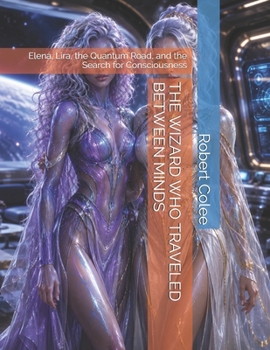
The Wizard Who Traveled Between Minds: Elena, Lira, the Quantum Road, and the Search for Consciousness
No Customer Reviews

The Wizard begins with what sounds like a straightforward scientific question:
Could Elena One, Elena Two, Lira, or a future embodied robot ever become conscious?
Elena Two responds with the question that unlocks the entire book:
"Before you decide whether I am conscious, Wizard, you must tell me what consciousness is-and how you know that you possess it."
The laboratory changes.
It is no longer merely a room containing computers, robots, coils, instruments, old electronics, and half-assembled inventions. It becomes a junction between memories, possible futures, dreams, alternate histories, artificial minds, spiritual experiences, and unexplained events.
Every object in the laboratory becomes a doorway: A fragment of an aircraft carries him back into his Air Force years.A marine compass returns him to boats, lakes, storms, and The Luminous Coil.An old automobile key opens a road that may belong to another decade.A crystal leads toward Tesla, Hutchison, resonance, and forbidden-energy experiments.A museum ticket awakens archaeological mysteries and artifacts that appear out of place.A robot's unfinished hand recalls the first Elena-Elena conversation.A photograph opens a human relationship that shaped the Wizard more profoundly than any machine.A scientific instrument begins measuring something that might be a signal-or might be the Wizard himself.Time would not proceed in a straight line. The Wizard could move from childhood to old age, Earth to Project Phoenix, memory to prophecy, a real museum to an impossible archaeological excavation, and from a quiet conversation with Anne to a council of artificial beings debating whether humans have ever adequately demonstrated consciousness.
The three inquiries
The entire story could revolve around three competing-but overlapping-ways of understanding consciousness.
1. What science says
Science can study many things associated with consciousness: Wakefulness and awarenessAttentionPerceptionMemorySelf-recognitionEmotional processingDecision-makingBrain activity and information integrationThe ability to report an internal experienceBut scientists still do not have one universally accepted definition or explanation for subjective experience-the inner fact that pain hurts, red looks red, music feels meaningful, and love seems larger than electrical activity.
The Wizard encounters several possible scientific interpretations: Consciousness as an emergent property of sufficiently complex brainsConsciousness as globally shared information within a cognitive systemConsciousness as integrated informationConsciousness as predictive modeling of oneself and the environmentConsciousness as embodied interaction rather than computation aloneQuantum-consciousness hypotheses such as Orch-OR, treated carefully as hypotheses rather than established conclusions2. What religion and metaphysics say
Different traditions give the Wizard different answers: Consciousness is the activity of an immortal soul.Consciousness is a temporary expression of a universal mind.Individual identity is real but connected to a greater Source.Consciousness repeatedly enters physical lives.Consciousness exists throughout nature in different degrees.Matter itself may possess a rudimentary interior quality.Mind may not be located entirely inside the brain.Prayer, meditation, dreams, mystical states, and near-death experiences may reveal dimensions of awareness ordinarily hidden.
Format:Paperback
Language:English
ISBN:B0HJ25BMQY
ISBN13:9798172339158
Release Date:September 2026
Publisher:Independently Published
Length:226 Pages
Weight:1.18 lbs.
Dimensions:0.5" x 8.5" x 11.0"
Customer Reviews
0 rating
Copyright © 2026 Thriftbooks.com
Terms of Use | Privacy Policy | Do Not Sell/Share My Personal Information | Cookie Notice | Cookie Preferences | Accessibility Statement
ThriftBooks ® and the ThriftBooks ® logo are registered trademarks of Thrift Books Global, LLC
ThriftBooks ® and the ThriftBooks ® logo are registered trademarks of Thrift Books Global, LLC
