


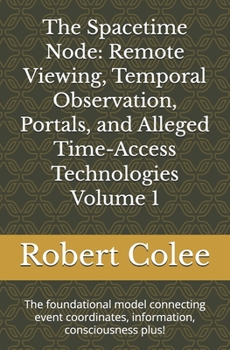
The Spacetime Node: Remote Viewing, Temporal Observation, Portals, and Alleged Time-Access Technologies Volume 1: The foundational model connecting ev
No Customer Reviews

A better term than "time node"
"Time node" is a useful starting expression, but I recommend a more precise term:
Spacetime Information Address
A spacetime information address would identify an event through a multidimensional set of coordinates:
A=A = {x, y, z, t, R, O, S, C\}A=
where: x, y, zx, y, zx, y, z identify spatial position;ttt identifies temporal position;RRR identifies the relevant reference frame;OOO describes the observer or observation conditions;SSS identifies the desired physical or informational state;CCC represents contextual information needed to distinguish the event from similar events.The central hypothesis would be:
An event may not merely disappear after it occurs. It may remain encoded in the causal and informational structure of the universe, while access to it depends on correctly addressing, resolving, and reconstructing that information.
That statement is a research hypothesis, not an established scientific conclusion.
Other names we could use include: event coordinate;temporal reference node;worldline address;spacetime resonance coordinate;causal-state address;consciousness-access coordinate;holographic event index.For the book and white-paper series, Spacetime Node is memorable, while Spacetime Information Address is the stronger engineering term. 2. The first essential distinction: seeing is not traveling
Much confusion disappears when the subject is divided into four different technological objectives.
Mode I: Temporal observation
The operator receives information about a past, future, or distant event but does not physically enter it.
Examples associated with this category include: remote viewing;precognition;the alleged Chronovisor;Project Looking Glass accounts;reconstructed historical imagery;quantum or computational prediction.This is essentially a read-only system.
Mode II: Consciousness projection
The observer reports that awareness, perception, or a nonphysical aspect of identity moves to another location or time while the body remains behind.
This category includes accounts of: extended remote viewing;out-of-body perception;alleged psychic time travel;consciousness relocation;some "super-soldier" memory narratives.This would be a remote-presence system, not necessarily physical transportation.
Mode III: Information transfer
A signal, message, measurement, or quantum state moves across an unusual causal path.
This could involve: delayed-choice experiments;retrocausal interpretations;closed timelike curves in mathematical models;wormhole-mediated information;quantum teleportation, which transfers a quantum state rather than transporting matter instantaneously.This is a communications problem.
Mode IV: Physical translation
A person or physical object allegedly enters a portal and emerges elsewhere-or elsewhen.
This includes the "sliding glass door" concept you described and claims associated with: Montauk's alleged time tunnel;Project Pegasus;teleportation chambers;Einstein-Rosen bridges;traversable wormholes;alleged jump rooms.This is the most demanding category because it requires control of matter, energy, causality, navigation, and biological integrity.
"Time node" is a useful starting expression, but I recommend a more precise term:
Spacetime Information Address
A spacetime information address would identify an event through a multidimensional set of coordinates:
A=A = {x, y, z, t, R, O, S, C\}A=
where: x, y, zx, y, zx, y, z identify spatial position;ttt identifies temporal position;RRR identifies the relevant reference frame;OOO describes the observer or observation conditions;SSS identifies the desired physical or informational state;CCC represents contextual information needed to distinguish the event from similar events.The central hypothesis would be:
An event may not merely disappear after it occurs. It may remain encoded in the causal and informational structure of the universe, while access to it depends on correctly addressing, resolving, and reconstructing that information.
That statement is a research hypothesis, not an established scientific conclusion.
Other names we could use include: event coordinate;temporal reference node;worldline address;spacetime resonance coordinate;causal-state address;consciousness-access coordinate;holographic event index.For the book and white-paper series, Spacetime Node is memorable, while Spacetime Information Address is the stronger engineering term. 2. The first essential distinction: seeing is not traveling
Much confusion disappears when the subject is divided into four different technological objectives.
Mode I: Temporal observation
The operator receives information about a past, future, or distant event but does not physically enter it.
Examples associated with this category include: remote viewing;precognition;the alleged Chronovisor;Project Looking Glass accounts;reconstructed historical imagery;quantum or computational prediction.This is essentially a read-only system.
Mode II: Consciousness projection
The observer reports that awareness, perception, or a nonphysical aspect of identity moves to another location or time while the body remains behind.
This category includes accounts of: extended remote viewing;out-of-body perception;alleged psychic time travel;consciousness relocation;some "super-soldier" memory narratives.This would be a remote-presence system, not necessarily physical transportation.
Mode III: Information transfer
A signal, message, measurement, or quantum state moves across an unusual causal path.
This could involve: delayed-choice experiments;retrocausal interpretations;closed timelike curves in mathematical models;wormhole-mediated information;quantum teleportation, which transfers a quantum state rather than transporting matter instantaneously.This is a communications problem.
Mode IV: Physical translation
A person or physical object allegedly enters a portal and emerges elsewhere-or elsewhen.
This includes the "sliding glass door" concept you described and claims associated with: Montauk's alleged time tunnel;Project Pegasus;teleportation chambers;Einstein-Rosen bridges;traversable wormholes;alleged jump rooms.This is the most demanding category because it requires control of matter, energy, causality, navigation, and biological integrity.
Format:Paperback
Language:English
ISBN:B0HBFSSHVP
ISBN13:9798188874568
Release Date:July 2026
Publisher:Independently Published
Length:288 Pages
Weight:0.66 lbs.
Dimensions:0.6" x 5.3" x 8.0"
Related Subjects
Science Science & Math Science & Scientists Science & Technology Waves & Wave MechanicsCustomer Reviews
0 rating
Copyright © 2026 Thriftbooks.com
Terms of Use | Privacy Policy | Do Not Sell/Share My Personal Information | Cookie Notice | Cookie Preferences | Accessibility Statement
ThriftBooks ® and the ThriftBooks ® logo are registered trademarks of Thrift Books Global, LLC
ThriftBooks ® and the ThriftBooks ® logo are registered trademarks of Thrift Books Global, LLC
