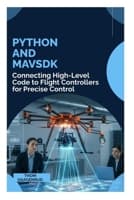
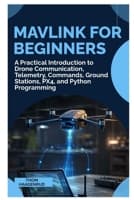
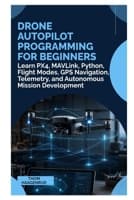
Learn how autonomous aircraft work, how their systems communicate, and how to build software that can interact with them safely.
Autonomous drones bring together software, electronics, sensors, control systems, communication networks, and physical flight. For beginners, the challenge is rarely learning one tool by itself. The real difficulty is understanding how all the parts cooperate during an actual autonomous operation.
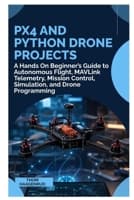
The Beginner's Guide to Autonomous Drones provides a structured introduction to the complete development process.
Instead of treating flight software, communication protocols, simulation tools, and programming libraries as separate topics, this book explains how they connect as one complete system.
You will begin by understanding:
- How autonomous aircraft make decisions
- The difference between manual, assisted, automatic, and autonomous operation
- The sense-estimate-decide-control loop behind autonomous behavior
- The roles of flight controllers, sensors, actuators, companion computers, and ground applications
- How autopilot software manages stability, navigation, communication, and safety
The book then moves into practical development.
You will learn how to:
- Create a PX4 development environment
- Work with QGroundControl for configuration, planning, monitoring, and analysis
- Build and test a Software In The Loop simulation environment
- Understand vehicle states, flight modes, coordinates, and setpoints
- Communicate with aircraft systems using MAVLink concepts
- Work with telemetry, parameters, commands, acknowledgements, and secure communication
- Develop Python applications for vehicle monitoring and automation
- Connect applications using MAVSDK
- Read vehicle information such as position, altitude, battery state, GPS status, and operating mode
- Create automated takeoff and landing workflows
- Build waypoint based operations
- Monitor mission progress and handle failures
- Control movement using Offboard techniques
- Understand coordinate frames and dynamic setpoints
- Troubleshoot failed operations using logs and evidence instead of guesswork
A major focus of the book is developing reliable engineering habits. You will learn why simulation should come before hardware, why vehicle state must be checked before commands are issued, and why successful autonomous systems require planned failure handling rather than only successful execution.
The practical projects gradually increase in complexity:
- A simulated aircraft environment
- A Python connection to the aircraft
- A telemetry monitoring application
- Automated takeoff and landing
- Multi-waypoint missions
- Offboard motion experiments
- Troubleshooting and testing workflows
- Transition from simulation to real autonomous systems
The final stages prepare you for real-world development by covering hardware preparation, companion computers, controlled testing, deployment considerations, security, multi-vehicle concepts, ROS 2, and computer vision pathways.
This book is designed for:
- Beginners entering autonomous systems
- Python developers interested in robotics
- Engineering and computer science students
- Drone enthusiasts moving beyond manual operation
- Developers exploring robotics and unmanned systems
No previous autonomous aircraft development experience is required. The book focuses on building understanding first, then turning that understanding into practical skills through controlled experiments and projects.
If you want to move beyond flying drones and start understanding the software, systems, and engineering principles behind autonomous operation, this book provides a clear foundation.