


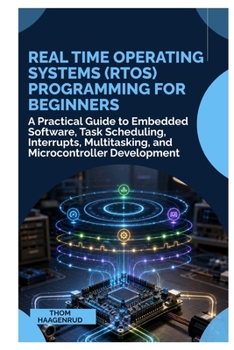
Real Time Operating Systems (RTOS) Programming for Beginners: A Practical Guide to Embedded Software, Task Scheduling, Interrupts, Multitasking, and M
No Customer Reviews

Learn how embedded systems manage multiple tasks, meet timing requirements, and run reliable real-time software.
Modern embedded devices are expected to perform many activities at once. A controller may need to read sensors, manage communication, update displays, record data, respond to user inputs, and maintain precise control loops while operating with limited memory and processing power. A simple loop may work at the beginning, but as complexity grows, timing conflicts and unpredictable behavior become difficult to manage. Real Time Operating Systems (RTOS) Programming for Beginners provides a practical pathway into designing concurrent embedded software using RTOS concepts. This book explains how a real-time operating system helps developers organize embedded applications into independent tasks, define priorities, coordinate events, transfer data safely, and reason about timing behavior. You will learn how to: Understand what real-time actually meansDistinguish deterministic behavior from simply running fasterAnalyze latency, execution time, response time, deadlines, and jitterMove from bare-metal superloop designs to task-based architecturesUnderstand RTOS kernels, schedulers, tasks, and context switchingDesign applications around timing requirements instead of intuitionCreate tasks with clear responsibilities and predictable behaviorChoose priorities based on system requirementsUnderstand blocking, delays, timeouts, and event-driven executionWork with interrupts and ISR-to-task communicationUse queues, notifications, semaphores, mutexes, and event groups correctlyManage shared resources safelyAvoid common concurrency mistakesDesign periodic activities without timing driftManage stacks, heaps, memory ownership, and resource limitsBuild RTOS-friendly drivers and embedded software architecturesDebug timing failures, race conditions, deadlocks, and resource problemsImprove reliability through testing, tracing, monitoring, and fault handlingThe book uses FreeRTOS-style examples because FreeRTOS is widely used on microcontrollers and clearly demonstrates fundamental RTOS concepts. However, the engineering principles apply broadly to other RTOS environments including Zephyr, ThreadX/Eclipse ThreadX, CMSIS-RTOS2, embOS, NuttX, and RTEMS. Basic C programming knowledge is recommended. No previous RTOS experience is required. The book starts from the microcontroller superloop model and gradually builds toward professional concurrent embedded software design. If you want to understand how reliable embedded devices coordinate multiple activities while meeting timing requirements, Real Time Operating Systems (RTOS) Programming for Beginners provides the practical foundation.
Modern embedded devices are expected to perform many activities at once. A controller may need to read sensors, manage communication, update displays, record data, respond to user inputs, and maintain precise control loops while operating with limited memory and processing power. A simple loop may work at the beginning, but as complexity grows, timing conflicts and unpredictable behavior become difficult to manage. Real Time Operating Systems (RTOS) Programming for Beginners provides a practical pathway into designing concurrent embedded software using RTOS concepts. This book explains how a real-time operating system helps developers organize embedded applications into independent tasks, define priorities, coordinate events, transfer data safely, and reason about timing behavior. You will learn how to: Understand what real-time actually meansDistinguish deterministic behavior from simply running fasterAnalyze latency, execution time, response time, deadlines, and jitterMove from bare-metal superloop designs to task-based architecturesUnderstand RTOS kernels, schedulers, tasks, and context switchingDesign applications around timing requirements instead of intuitionCreate tasks with clear responsibilities and predictable behaviorChoose priorities based on system requirementsUnderstand blocking, delays, timeouts, and event-driven executionWork with interrupts and ISR-to-task communicationUse queues, notifications, semaphores, mutexes, and event groups correctlyManage shared resources safelyAvoid common concurrency mistakesDesign periodic activities without timing driftManage stacks, heaps, memory ownership, and resource limitsBuild RTOS-friendly drivers and embedded software architecturesDebug timing failures, race conditions, deadlocks, and resource problemsImprove reliability through testing, tracing, monitoring, and fault handlingThe book uses FreeRTOS-style examples because FreeRTOS is widely used on microcontrollers and clearly demonstrates fundamental RTOS concepts. However, the engineering principles apply broadly to other RTOS environments including Zephyr, ThreadX/Eclipse ThreadX, CMSIS-RTOS2, embOS, NuttX, and RTEMS. Basic C programming knowledge is recommended. No previous RTOS experience is required. The book starts from the microcontroller superloop model and gradually builds toward professional concurrent embedded software design. If you want to understand how reliable embedded devices coordinate multiple activities while meeting timing requirements, Real Time Operating Systems (RTOS) Programming for Beginners provides the practical foundation.
Format:Paperback
Language:English
ISBN:B0HGQQ73W7
ISBN13:9798170144747
Release Date:August 2026
Publisher:Independently Published
Length:192 Pages
Weight:0.53 lbs.
Dimensions:0.5" x 6.0" x 9.0"
Customer Reviews
0 rating
Copyright © 2026 Thriftbooks.com
Terms of Use | Privacy Policy | Do Not Sell/Share My Personal Information | Cookie Notice | Cookie Preferences | Accessibility Statement
ThriftBooks ® and the ThriftBooks ® logo are registered trademarks of Thrift Books Global, LLC
ThriftBooks ® and the ThriftBooks ® logo are registered trademarks of Thrift Books Global, LLC
