


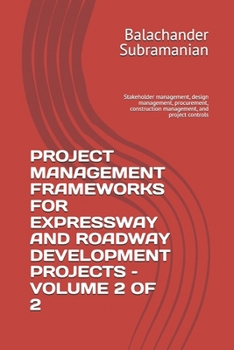
PROJECT MANAGEMENT FRAMEWORKS FOR EXPRESSWAY AND ROADWAY DEVELOPMENT PROJECTS – VOLUME 2 OF 2: Stakeholder management, design management, procurement, construction management, and project controls
No Customer Reviews

Infrastructure is one of the most important drivers of economic development, regional connectivity, social mobility, and national prosperity. Expressways and roadway networks not only connect cities, industries, and communities but also create opportunities for sustainable growth, improved logistics, enhanced public safety, and long-term economic competitiveness. However, delivering highway infrastructure successfully has become increasingly complex. Modern projects involve multiple stakeholders, multidisciplinary engineering, stringent environmental and regulatory requirements, advanced construction technologies, digital engineering, extensive procurement activities, and sophisticated project controls. While technical engineering standards are well established across the highway industry, organizations often struggle with the absence of standardized management frameworks that define how projects should be governed, coordinated, monitored, and controlled throughout their lifecycle. As a result, many projects experience schedule delays, cost overruns, interface conflicts, contractual disputes, inefficient decision-making, and inconsistent management practices. This book has been written to address that challenge. Project Management Frameworks for Expressway and Roadway Development Projects - Volume 2 of 2 presents a structured collection of twenty-five comprehensive management frameworks that provide practical governance models for managing highway projects from stakeholder coordination through engineering design, procurement, construction execution, and integrated project controls. Each framework follows a consistent methodology including: PurposeFramework ObjectivesLifecycle FlowchartsGovernance StructuresGuiding PrinciplesPhase-by-Phase Implementation ProcessesSupporting FrameworksDigital Engineering ApplicationsRisk ManagementKey Performance IndicatorsStage-Gate GovernanceCritical Success FactorsFramework BenefitsThe objective is not merely to explain project management concepts, but to provide a practical implementation manual that organizations can directly adapt into their own procedures, standard operating procedures (SOPs), governance manuals, quality systems, project execution plans, and organizational standards. This volume complements Volume 1, together forming an integrated reference covering the complete lifecycle of expressway and roadway development projects-from strategic planning and feasibility through design, procurement, construction, commissioning, operations, maintenance, and asset management. Whether managing a national expressway program, a public-private partnership (PPP), an urban transportation corridor, or a rural highway improvement initiative, the principles presented in this book are intended to support consistent governance, improved collaboration, enhanced project controls, and successful project delivery. Ultimately, successful highway projects are not delivered solely through excellent engineering-they are delivered through disciplined management, effective coordination, structured governance, informed decision-making, and continuous improvement. This book has been developed to support those objectives and to contribute to the advancement of professional project management practices across the global transportation infrastructure industry.
Format:Paperback
Language:English
ISBN:B0H9DW7DPM
ISBN13:9798187813117
Release Date:July 2026
Publisher:Independently published
Length:480 Pages
Weight:1.41 lbs.
Dimensions:9.0" x 1.1" x 6.0"
Customer Reviews
0 rating
Copyright © 2026 Thriftbooks.com
Terms of Use | Privacy Policy | Do Not Sell/Share My Personal Information | Cookie Policy | Cookie Preferences | Accessibility Statement
ThriftBooks ® and the ThriftBooks ® logo are registered trademarks of Thrift Books Global, LLC
ThriftBooks ® and the ThriftBooks ® logo are registered trademarks of Thrift Books Global, LLC
