


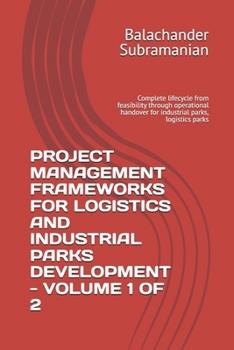
Project Management Frameworks for Logistics and Industrial Parks Development - Volume 1 of 2: Complete lifecycle from feasibility through operational
No Customer Reviews

Industrialization has long been recognized as one of the strongest catalysts for sustainable economic growth, employment generation, technological advancement, export competitiveness, and national prosperity. Around the world, governments and private developers continue to invest billions of dollars in industrial parks, logistics parks, manufacturing clusters, Special Economic Zones (SEZs), Free Trade Zones (FTZs), Inland Container Depots (ICDs), Multimodal Logistics Parks (MMLPs), and integrated industrial townships to strengthen supply chains, attract foreign direct investment, and support long-term economic development. Despite these massive investments, many industrial park developments experience significant challenges. Projects frequently suffer from poor site selection, inadequate feasibility studies, fragmented planning, regulatory delays, weak stakeholder coordination, ineffective procurement strategies, uncontrolled costs, schedule overruns, infrastructure integration issues, environmental compliance risks, and operational readiness deficiencies. These challenges often lead to delayed project delivery, increased capital expenditure, reduced investor confidence, lower occupancy rates, and diminished financial returns. The successful development of a world-class logistics or industrial park requires far more than conventional project management techniques. It demands a comprehensive governance framework that integrates strategic planning, technical engineering, commercial analysis, infrastructure development, sustainability, digital transformation, stakeholder engagement, financial management, and operational excellence into one coordinated methodology. This book has been written to address that need. Project Management Frameworks for Logistics and Industrial Parks Development - Volume 1 presents a structured collection of practical management frameworks that guide project teams throughout the complete development lifecycle. Rather than focusing solely on engineering design or construction execution, this handbook establishes governance systems, decision-making models, implementation methodologies, performance metrics, stage-gate approvals, risk management practices, and project controls required to successfully deliver industrial developments from concept through commissioning. The frameworks contained within this volume have been organized according to internationally recognized project management principles while incorporating practical lessons from major infrastructure and industrial developments worldwide. They align with globally accepted practices in project governance, infrastructure planning, project controls, sustainability, commercial management, and lifecycle asset management. Each framework has been developed using a consistent structure that includes: Purpose and objectivesScope of applicationProcess workflowGovernance structureRoles and responsibilitiesPhase-by-phase implementation methodologyKey deliverablesStage-Gate approval modelRisk considerationsKey Performance Indicators (KPIs)Critical Success FactorsRecommended management practicesThe result is a practical reference that can be immediately adopted by owners, developers, consultants, contractors, and government agencies responsible for planning and delivering industrial developments. Whether developing a regional logistics hub, a national manufacturing cluster, a free trade zone, or a multinational industrial township, the principles contained in this handbook provide a structured pathway toward predictable, transparent, and successful project delivery.
Format:Paperback
Language:English
ISBN:B0H8NV49T7
ISBN13:9798187063697
Release Date:July 2026
Publisher:Independently Published
Length:586 Pages
Weight:1.70 lbs.
Dimensions:1.2" x 6.0" x 9.0"
Customer Reviews
0 rating
Copyright © 2026 Thriftbooks.com
Terms of Use | Privacy Policy | Do Not Sell/Share My Personal Information | Cookie Policy | Cookie Preferences | Accessibility Statement
ThriftBooks ® and the ThriftBooks ® logo are registered trademarks of Thrift Books Global, LLC
ThriftBooks ® and the ThriftBooks ® logo are registered trademarks of Thrift Books Global, LLC
