


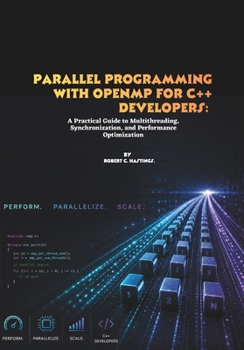
Parallel Programming with OpenMP for C++ Developers: A Practical Guide to Multithreading, Synchronization, and Performance Optimization

Have you ever spent weeks optimizing an intensive algorithm, finally parallelized it, and watched in frustration as it actually ran slower than the single-threaded version? I certainly have.
The compiler did not warn you. The mathematical logic was completely flawless. So, what went wrong? The problem was not your software; it was the physical silicon. Hardware caches were quietly destroying each other. Threads were trapped at invisible synchronization barriers. The operating system was secretly shifting your data across the motherboard. I wrote this book to expose these silent performance killers. I will show you exactly how to stop guessing, identify the hardware roadblocks, and take absolute command of the physical processor.
What's insideThe Fork-Join Model: Safely wake, distribute, and manage thread teams without triggering massive system overhead.Strict Memory Scoping: Eliminate unpredictable data corruption by meticulously isolating private and shared variables.Asynchronous Tasking: Process highly unpredictable structures like linked lists, recursive trees, and dynamic while-loops.Hardware-Level Optimization: Defeat the silent threat of false sharing and align your data for perfect cache utilization.NUMA Architecture: Pin your threads to specific physical cores and prevent costly memory migrations.GPU Offloading: Push beyond the limits of the CPU and send your heaviest mathematical calculations directly to accelerator hardware.
Who it's meant for
This guide is designed for intermediate to advanced C++ software engineers, researchers, and computer science professionals who need to process massive amounts of data at maximum speed. If you understand basic C++ loops and memory pointers but have struggled to make your applications scale efficiently across multiple CPU cores, this is exactly where you belong.
Stop leaving the vast majority of your computer's processing power sitting completely idle. It is time to abandon unpredictable performance and start engineering with scientific precision. Grab your copy today, take command of the hardware, and build C++ software that operates at the absolute physical limits of modern technology.Customer Reviews
ThriftBooks ® and the ThriftBooks ® logo are registered trademarks of Thrift Books Global, LLC
