


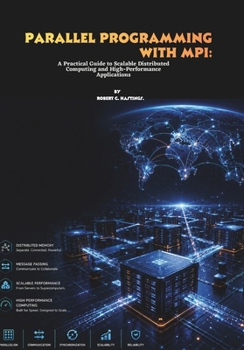
Parallel Programming with MPI: A Practical Guide to Scalable Distributed Computing and High-Performance Applications

This book is a comprehensive guide to engineering highly optimized, distributed C++ applications. It teaches you how to construct software that scales seamlessly from a local workstation to an enterprise supercomputing cluster without wasting a single CPU cycle.
I know exactly what it feels like to watch a carefully written application collapse under its own weight. You optimize your mathematics on one machine, only to watch the software freeze or crash the moment you try to scale it up. The hard truth is that the standard rules of software development fail at massive scale. Standard file operations throttle your storage drives, and synchronous network messages force your CPUs to sit entirely idle. What happens when your dataset grows so large that a single server simply cannot process it? You must change your entire execution architecture. I wrote this guide to show you exactly how to bypass the operating system, manipulate physical RAM across networks, and coordinate thousands of nodes without a single collision.
What's Inside: The Architecture of Scale
This guide is packed with rigorous, highly practical techniques to transform how you write software:
Custom Memory Mapping: Transmit complex C++ structures instantly using zero-copy communication.Asynchronous Execution: Master Remote Memory Access to seamlessly alter remote RAM without interrupting active calculations.Parallel Storage Pipelines: Coordinate collective I/O to write massive datasets at absolute hardware speed.Hybrid Processing: Unify MPI and OpenMP to completely dominate modern multi-core servers.Dynamic Load Balancing: Eliminate idle time by constructing highly efficient master-worker task queues.Who It's Meant For: Systems Engineers
This guide is written for C++ developers and software architects who refuse to accept hardware limitations. If you want to elevate your engineering skills to command massive computing clusters, this is your direct roadmap.
Stop writing software that is permanently trapped inside a single computer. Your hardware is capable of infinite parallel execution, and it is time you unlock that potential. Grab your copy now, rewrite your architecture, and start engineering the scalable systems of tomorrow.
Customer Reviews
ThriftBooks ® and the ThriftBooks ® logo are registered trademarks of Thrift Books Global, LLC
