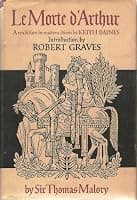
The legends of King Arthur and his knights of the Round Table have inspired some of the greatest works of literature--from Cervantes's Don Quixote to Tennyson's Idylls of the King. Although many versions exist, Malory's stands as the classic rendition. Malory wrote the book while in Newgate Prison during the last three years of his life; it was published some fourteen years later, in 1485, by William Caxton. The tales, steeped in the magic of Merlin, the powerful cords of the chivalric code, and the age-old dramas of love and death, resound across the centuries. The stories of King Arthur, Lancelot, Queen Guenever, and Tristram and Isolde seem astonishingly moving and modern. Malory's Le Morte d'Arthur endures and inspires because it embodies mankind's deepest yearnings for brotherhood and community, a love worth dying for, and valor, honor, and chivalry. "From the Trade Paperback edition."
Malory consolidates all of the legend of King Arthur’s court from Arthur’s conception to his death. This book is separated into 21 smaller “books”, which are organized mostly chronologically, but they are separated by topic. So you can read out of order if you only want to read the part dedicated to the search for the holy grail, or if you would just like to read about Tristram and Isould, or only the books dedicated to Launcelot.
1
★☆☆☆☆
Not what i wanted
By Kenji, February 10, 2026
Verified Purchase
Was hoping for the middle-english text
0
★★★☆☆
Authentic Stories of King Arthur & his Knights
By Vicki9, December 29, 2025
Verified Purchase
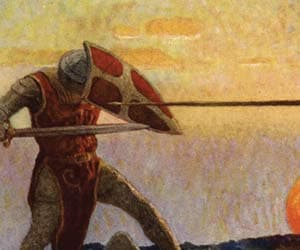
I love the idea that this book has authentic stories. I also love the illustrations. However the writing is story-driven rather character-driven. This means that the stories read almost like a history without any insights into motivation or emotions of the characters. I find it interesting although rather boring. I didn’t see the age or grade designations. But I read many books at even younger ages. These books described motivations and character emotions. So I don’t believe this is a reason for the boring story writing.
0
★★★★★
Le Morte Darthur
By Thriftbooks.com User, October 21, 2009
Great copy of the book. No marking or folded corners. Arrived in a timely manner.
1
★★★★★
If I only had one book . . .
By Thriftbooks.com User, December 21, 2005
If I had only one book to read for the rest of my life and couldn't read anything else, it would be this one.
7
★★★★★
The once and future king...
By Thriftbooks.com User, September 9, 2005
Sir Thomas Mallory was a great one to write the adventures of King Arthur and his knights - a knight himself, he led a life of intrigue and adventure, albeit not one that always lived up to the ideas of chivalry he penned at the heart of the Arthurian legends. Mallory did not invent Arthur; he is one of the principle medieval chroniclers, having time (he was in prison with nothing else to do, after all) to set down in prose stories he'd heard throughout his life. These were popular tales, not always told in the same way with the same details, as is true of most oral legends and transmitted stories, much to the later frustration of scholars and readers. The earliest printing of Mallory's stories had his authorship suppressed by Caxton, one of the better-known publishers of the time. The earliest Arthurian legends date back as far as the late Roman times in Britain. Controversies abound, but many have settled on a late Roman or Romano-British general named Arturius - however, given the linguistic nature of the name (it is derivative of ruler or leader), it is impossible to know if this was in fact a name or a title, and the legends may be compilations of the acts of many leaders bearing the name. There was also a Welsh leader with the name/title Arddu, 'Dark One', who is sometimes conflated into Arthurian legend. Arthur was celebrated in the pre-Norman times for the order and stability he represented; Arthur was celebrated in post-Norman times for his campaigns against Saxons. Arthur continues to be an intriguing character, today reminiscent of ancient mysteries as well as pagan and new age ideas as well. In any event, Mallory doesn't attach specific dates to his tales. The book actually consists of many tales. The first is entitled 'The Tale of King Arthur', which introduces the figures of Merlin, Gawain, Uwayne, Pellinore, Morgan le Fay (the Celtic war goddess Morgana, dressed up as Arthur's sister) and others, and includes the sword-in-the-stone event. While this text has been modernised by Keith Baines, there are certain crucial lines left in Mallory's English, including this most famous one: Whoso pulleth oute this swerd of this stone and anvyld is rightwys kynge borne of all Brytaygne Following this tale, Mallory includes many of the famous tales in Arthurian legend as stories more or less complete in themselves, but still linking to the other tales. 'The Tale of Sir Lancelot du Lake' is a knight's tale indeed, with no fewer than twenty horseback duels back-to-back. 'The Tale of Sir Gareth' is a similar spirited tale, less well known. 'The Book of Sir Tristram of Lyoness' makes Tristram and Iseult, famous by other writers as well, into lovers, this time with a more happy ending than usual. The lesser known 'Tale of Arthur and Lucius' describes battles and skirmishes with the emperor, but never really captured popular imagination. Mallory saves the best for last, with three major tales - 'The Tale of the Sangreal', the Holy Grail; 'The B
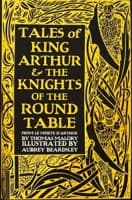
In 1891, a young artist named Aubrey Beardsley walked into London bookseller Frederick Evans' shop and met J.M. Dent, then a new relatively new publisher. The book dealer and publisher were engaged in a conversation about Sir Thomas Malory's Morte Darthur which at the time was undergoing a renewed popularity...