


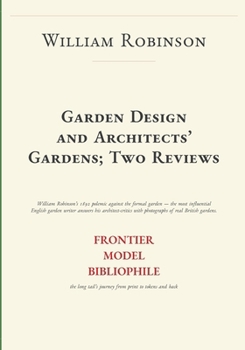
Garden Design and Architects' Gardens; Two Reviews (Frontier Model Bibliophile Facsimiles)
No Customer Reviews

In 1892 the leading champion of the English natural garden took up a pen against the architects who would have him clip his yews and align his trees. William Robinson - Irish-born horticultural journalist, founder of The Garden, author of The Wild Garden (1870) and The English Flower Garden (1883) - had spent two decades teaching Britain to plant in drifts, in cottage borders, in unforced naturalistic groupings. Then John Sedding's Garden-Craft Old and New (1891) and Reginald Blomfield's The Formal Garden in England (1892) declared the natural school an aesthetic failure. Garden Design and Architects' Gardens is Robinson's reply: two long reviews, lavishly illustrated with photographs of real British country seats, demonstrating that the case against the natural garden cannot survive contact with actual gardens. The book is short, furious, evidence-based, and unmistakably the work of a man who knew every great garden in the kingdom. Its influence runs forward through Gertrude Jekyll, Vita Sackville-West, Christopher Lloyd, and the entire modern English planting tradition. Garden Design and Architects' Gardens is a slim polemical book - under one hundred and fifty pages, lavishly illustrated with half-tone photographs of British country-house gardens - in which the most prolific English garden writer of his generation answers two recently published architect-authored attacks on the naturalistic style he had spent twenty years promoting. The subtitle states the argument with unusual directness, almost combatively: the book is intended to show, "by actual examples from British gardens, that clipping and aligning trees to make them harmonise' with architecture is barbarous, needless, and inartistic." It is not a treatise on horticulture, not a manual on planting, not a survey of gardens. It is a sustained rebuttal, structured as two book reviews, in which Robinson quotes his opponents at length, paragraph by paragraph, and answers them with photographs of real gardens that, in his view, simply do not look like the formal-style writers say English gardens should look. The form is unusual - review-as-book - and gives the volume an unusually concentrated energy. The book emerged from a sharp public controversy that had its first round in 1891-1892. John Dando Sedding, an Arts-and-Crafts ecclesiastical architect, published Garden-Craft Old and New in 1891, defending the architectural garden against what he saw as the formless naturalism of the landscape school. Reginald Blomfield, with the illustrator F. Inigo Thomas, followed in 1892 with The Formal Garden in England, a more historically argued case for the geometric Italianate tradition that had dominated seventeenth-century English garden-making. Robinson - by then editor of The Garden and one of the best-known horticultural voices in the English-speaking world, with the wide-circulation English Flower Garden (1883) already in its second edition - answered both books in the same year and from the same publisher who had carried his major works, John Murray of Albemarle Street. He used the methodological move that had defined his career: rather than argue style against style in the abstract, he opened the discussion to the evidence of existing gardens. The illustrations are the argument. The photographs of Crowsley Park, Drakelowe, Brockenhurst, Shrubland, and a dozen other late-Victorian gardens are not decoration; they are the exhibits in a brief. For the present-day reader the interest is not chiefly polemical. It is documentary. Robinson knew the great gardens of late-Victorian Britain at first hand - he had walked through them, advised on many of them, and recorded their planting in his journals - and he wrote about plant communities, about scale, about the relation of house to ground, with a degree of practical authority that no other writer of his generation could match.
Format:Paperback
Language:English
ISBN:B0HG4Q77MY
ISBN13:9798259506961
Release Date:May 2027
Publisher:Frontier Model Bibliophile
Length:154 Pages
Weight:0.62 lbs.
Dimensions:10.0" x 0.3" x 7.0"
Customer Reviews
0 rating
Copyright © 2026 Thriftbooks.com
Terms of Use | Privacy Policy | Do Not Sell/Share My Personal Information | Cookie Policy | Cookie Preferences | Accessibility Statement
ThriftBooks ® and the ThriftBooks ® logo are registered trademarks of Thrift Books Global, LLC
ThriftBooks ® and the ThriftBooks ® logo are registered trademarks of Thrift Books Global, LLC
