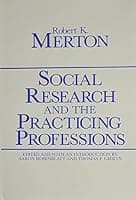
The 1956 edition of this book may be regarded as seminal within sociology, spawning a whole field of qualitative opinion research that has continued to evolve through half a century of inquiry. This is a reissue of the book, with a new preface by Merton, a select bibliography of writings on the focused interview and focus group research, and a new introduction that traces the diffusion of Merton's technique from sociology to other fields, including history, psychology, mass media and marketing research.
Market Researchers: It pays to get back to your roots. This is a foundation text worth revisiting.
By Thriftbooks.com User, January 13, 2006
Robert K Merton is a name largely forgotten in marketing research circles, yet he is widely credited as being the inventor of the focus group as a concept. It began when he was roped in by his colleague (another research giant)Paul Lazarsfeld to assist with a project looking at how groups of US soliders were reacting to Uncle Sam propaganda films. Merton observed some interviews and was appalled, basically, by the lack of technique. The questions were leading, the interviewer bias was showing (So how totally evil do you think these Nazi's are?) and... well, Merton took up Lazarsfeld's offer to lead the project. This was in the 1940s, and Lazarfeld's "Columbia school" was the dominant force in pioneering the art and science of Market Research. Many of the techniques we use today (often without question)came from these people. Merton went on to carve out his name as a great and influential sociologist, but not before he wrote this handy volume in 1951, a complete guide to the techniques of conducting a focused interview - that is, an interview that has an agenda to find evidence that helps prove or disprove a particular thesis. The original text became a bible for interviewers, and for good reason. While you'll find Merton's style a little dry, the book is fastidious in going through all aspects of the interview and discussing the philosophy behind what we're doing. Researchers, like golfers, need to be quite self-conscious, I feel, to go back and hone our skills and re-think our techniques and emerge (like Tiger Woods, I dare say, after redefining his swing) better and stronger as professionals. This book helps us literally to go back and revisit where our techniques and methods come from. It includes a forward in which Merton reasserts his role as a pioneer (I think it reads too self-justifyingly, and way too stuffily) but he has a fair point. When a great idea gets incorporated into society, or - as we see in this case - into a profession, then something is usually lost: the initial rationale perhaps. For your professional growth I recommend this volume strongly, and recommend a copy for your qualitative team. It helps you get back and question and polish the interview techniques we take for granted.