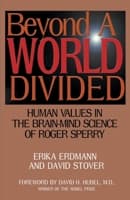
For ages there has been a gap between the two cultures of the sciences and religions. According to Roger Sperry, science can now bridge the gap between the cold hard facts of the sciences and humanitarian and religious values. Sperry won the Nobel Prize in 1981 for his work on the differences between the left and right halves of the brain. For the past twenty years he has been campaigning for human consciousness and values to be investigated scientificlly. This book describes Sperry's work and his struggle to guide humanity beyond a world divided. terms such as consciousness, value, love and joy are scientifically meaningful, just like terms referring to brain physiology, such as neural pathways and electrical impulse. The split between mind matter, or religion, and science can be removed, says Sperry, by expanding scientific research. Now, conscious experiences must be taken into account as scientific information about the brain. Our values, beliefs and goals can directly affect our brain states and physiology.
Sperry is most famous for his groundbreaking split-brain studies in epileptics, which so galvanized the popular imagination in the 60s and 70s that Sperry's name practically became a household word and the split-brain view of consciousness became a permanent part of the popular culture. However, in his later years, Sperry turned his mind to the problem of science and its relationship to society and of human values in general. This book examines these issues in the context of Sperry's thought and his contributions to neuroscience, and how his work continues to influence philosophical and neurobiological thought about the mind and brain. I studied Sperry's work myself in grad school as a young neurobiologist, and so I thought I'd make a few more comments there, as they provide another perspective on Sperry's work that complements the subject of this book, since, as I learned in grad school, there are both pro and con sides to Sperry's view of the brain derived from his famous split-brain studies. First, the pro side. Sperry's idea falls in general under the concept of the cortical specialization of cognitive abilities and there is no doubt there is some truth to that idea. For many years it's been clear that different areas of the cortex, and of the brain in general, are specialized for certain things. For example, the occipital lobes are involved in vision and perception, the temporal lobes are involved in memory and language, the lateral sulcus and gyrus area is involved with hearing, the pre-central or post-central gyrus (I can't recall which at this point) is involved in high-level motor functions, and the frontal cortex, which seemed the most amorphous and unspecialized of all in terms of its function, still has an important role in personality and behavior, and is intimately linked with the limbic system, where probably most of the motivations that drive our day-to-day behavior are produced. Now the con side. The problem with the simple right-brain/left brain hypothesis is the same as that for what is known as the classical ablation studies in neurobiology. Some years ago, a standard way of exploring the brain was to take animals like cats and mice and insert an electrode and destroy a specific part of the brain with an electrical current (this isn't done as much anymore), and then do exhaustive behavioral and cognitive tests to see what deficits the animal now had. The results of these experiments were often dramatic and led to the first rigorous descriptions of the functional neuranatomy of the various brain centers. (In neurobiology "functional neuroanatomy" is the area that seeks to correlate brain anatomy with function.) In the the same vein, a lot was learned for similar reasons from neurological patients from the two world wars who had damage to various areas of their brains. One time one of my professors made the remark that we also wouldn't know nearly as much about the functional neuroanatomy of the brain if it weren't for tee