


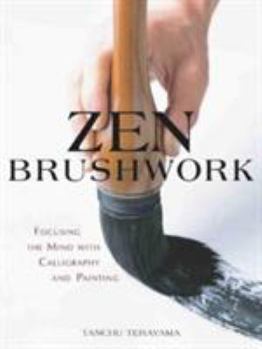
Zen Brushwork : Focusing the Mind with Calligraphy and Painting

With its bold strokes and mystic aura, Zen calligraphy has fascinated Westerners for decades, yet it remains an abstract, rarely practiced form of expression outside of Asia. Now, master calligrapher Tanchu Terayama explains the techniques behind this subtle art and offers step-by-step instructions for practicing it on a professional level. After introducing the basics, Terayama presents a unique meditative warm-up to establish the proper mental attitude needed to release one's creative energies. Next, the power of the brushed line is explained and demonstrated. What makes a good line or a bad one, an expressive effort or an unfocused one? Lessons on brushing symbolic Japanese characters follow, including those for "emptiness," "nothingness," and "flower." The painting section shows readers how to draw the spare yet elegant pictorial themes of this classic art: bamboo, plum blossoms, Mount Fuji, and the inspirational Zen priest Daruma. If the exercises are the heart of the book, the Appreciation section is the soul. This chapter introduces classic works from renowned priests and other historical figures, including Miyamoto Musashi (the celebrated swordsman and author of The Book of Five Rings), Morihei Ueshiba (the founder of aikido), Jigoro Kano (the father of judo), and Zen priest Hakuin. Each masterpiece is accompanied by penetrating commentary on the strengths and salient features of the work. Rarely has Zen calligraphy been demonstrated and discussed with such candor and insight. Illuminating yet another side of Zen, Zen Brushwork will be an invaluable source to those interested in meditation, Zen, Buddhism, the martial arts, and Oriental traditions in general. CONTENTS
Introduction
Part I Background
What is Zen Calligraphy?
The Evolution of Kanji
The Fundamentals of Calligraphy
The Four Treasures of Calligraphy
Hitsuzendo Part II Preparation-Warming Up and Developing Ki
The Zen Line
Yoki-ho: A Method of Developing Ki and Warming-Up
warm-up exercise 1: Yoki-ho: The Long Version
warm-up exercise 2: The Short Form of Yoki-ho: A Five-Minute Exercise
warm-up exercise 3: Kusho: Writing in the Air Part III Zen Calligraphy and Painting
Basic Practice
The Zen Line and Its Applications
exercise 1: Mujibo (The Zen Line)
exercise 2: Enso (The Zen Circle)
exercise 3: Horizontal and Vertical Lines
exercise 4: Fine Lines
Tensho (Seal Script)
exercise 5: So (Grass) and a Practice Line
Kaisho (Standard Script)
exercise 6: Sho (Calligraphy) and Practice Lines Further Practice
Sosho (Grass Script)
exercise 7: Mu (Nothing)
exercise 8: Hana (Flower)
exercise 9: Ku (Emptiness)
exercise 10: Mu Ichi Motsu (Owning No-thing)
exercise 11: Ichigyo Zanmai (Be in the Moment)
Writing Western Script
exercise 12: Writing Western Script: ABC
exercise 13: Shodo (Calligraphy) Painting
exercise 14: Orchid
exercise 15: Bamboo
exercise 16: Plum Blossoms (with inscription)
exercise 17: Mount Fuji
exercise 18: Daruma
exercise 19: Wall-Gazing Daruma
exercise 20: "One-Stroke" Daruma
exercise 21: Ji-Wa-Choku (Compassion, Harmony, Honesty) Part IV Appreciation
Works by Old Masters
Works by Terayama Tanchu
Glossary What is Zen Calligraphy?
Calligraphy (sho) is a formative art based on writing. It includes not only writing that is beautiful, but phrases that are novel and interesting. According to the Japanese philosopher Nishida Kitaro (1870-1945; see figure 1), true creativity is not the product of a conscious effort but rather the "phenomenon of life itself." True creation must arise from mu-shin, or the state of "no-mind," a state beyond thought, emotions, and expectations. Work that is produced through conscious effort is ultimately devoid of life. Zen calligraphy in particular must spring from shonen sozoku, a Buddhist term equivalent to "true thought." Shonen is a state of full concentration that is devoid of thoughts and ideas, while sozoku here means "free-flowing continuity." Greatness in brushwork cannot be achieved through conscious effort; it is only achieved through the states of mu-shin and shonen sozuku, or "no-mind" and a continuous state free of the thoughts and ideas that distract the mind. Zen calligraphy differs from other calligraphic disciplines as it is focused on the realization of "no-mind." Furthermore, in contrast tosho, which uses Chinese characters as a basis, it is the expression of Zen through a brush, whether the result is a single stroke, a Zen circle, or an ink painting. While sho is restricted to brushed writing, Zen calligraphy extends to other forms of brushwork. Nearly all calligraphy today is born of conscious attention to an aesthetic concept, but we rarely find lines that are truly alive. In contrast, the calligraphy of Zen masters such as Daito Kokushi (1282-1337; founder of Daitokuji temple in Kyoto) or Ikkyu Sojun (1394-1481) resonates with the energy of "no-mind" achieved through complete concentration. In these works, the lines are filled with vitality and the shapes are fresh and original. Sen no Rikyu (1522-91), who established many of the basic precepts of the tea ceremony, held that nothing surpassed Zen calligraphy as a subject for display in the alcove of the tea room. He undoubtedly felt that only art works that reflect the eternal vitality of Zen writings could encourage the mind toward enlightenment. Rikyu recognized that calligraphy necessarily demands the highest level of spirituality. A line that manifests clarity cannot be drawn if the heart is clouded by worldly concerns; a stroke cannot be brushed with resolution if the heart is agitated; and calligraphy that reveals depth cannot be produced if cultivation and experience are shallow. To write kanji characters that resonate and demonstrate their deeper meaning, one's own mind must achieve unity with the meaning
Introduction
Part I Background
What is Zen Calligraphy?
The Evolution of Kanji
The Fundamentals of Calligraphy
The Four Treasures of Calligraphy
Hitsuzendo Part II Preparation-Warming Up and Developing Ki
The Zen Line
Yoki-ho: A Method of Developing Ki and Warming-Up
warm-up exercise 1: Yoki-ho: The Long Version
warm-up exercise 2: The Short Form of Yoki-ho: A Five-Minute Exercise
warm-up exercise 3: Kusho: Writing in the Air Part III Zen Calligraphy and Painting
Basic Practice
The Zen Line and Its Applications
exercise 1: Mujibo (The Zen Line)
exercise 2: Enso (The Zen Circle)
exercise 3: Horizontal and Vertical Lines
exercise 4: Fine Lines
Tensho (Seal Script)
exercise 5: So (Grass) and a Practice Line
Kaisho (Standard Script)
exercise 6: Sho (Calligraphy) and Practice Lines Further Practice
Sosho (Grass Script)
exercise 7: Mu (Nothing)
exercise 8: Hana (Flower)
exercise 9: Ku (Emptiness)
exercise 10: Mu Ichi Motsu (Owning No-thing)
exercise 11: Ichigyo Zanmai (Be in the Moment)
Writing Western Script
exercise 12: Writing Western Script: ABC
exercise 13: Shodo (Calligraphy) Painting
exercise 14: Orchid
exercise 15: Bamboo
exercise 16: Plum Blossoms (with inscription)
exercise 17: Mount Fuji
exercise 18: Daruma
exercise 19: Wall-Gazing Daruma
exercise 20: "One-Stroke" Daruma
exercise 21: Ji-Wa-Choku (Compassion, Harmony, Honesty) Part IV Appreciation
Works by Old Masters
Works by Terayama Tanchu
Glossary What is Zen Calligraphy?
Calligraphy (sho) is a formative art based on writing. It includes not only writing that is beautiful, but phrases that are novel and interesting. According to the Japanese philosopher Nishida Kitaro (1870-1945; see figure 1), true creativity is not the product of a conscious effort but rather the "phenomenon of life itself." True creation must arise from mu-shin, or the state of "no-mind," a state beyond thought, emotions, and expectations. Work that is produced through conscious effort is ultimately devoid of life. Zen calligraphy in particular must spring from shonen sozoku, a Buddhist term equivalent to "true thought." Shonen is a state of full concentration that is devoid of thoughts and ideas, while sozoku here means "free-flowing continuity." Greatness in brushwork cannot be achieved through conscious effort; it is only achieved through the states of mu-shin and shonen sozuku, or "no-mind" and a continuous state free of the thoughts and ideas that distract the mind. Zen calligraphy differs from other calligraphic disciplines as it is focused on the realization of "no-mind." Furthermore, in contrast tosho, which uses Chinese characters as a basis, it is the expression of Zen through a brush, whether the result is a single stroke, a Zen circle, or an ink painting. While sho is restricted to brushed writing, Zen calligraphy extends to other forms of brushwork. Nearly all calligraphy today is born of conscious attention to an aesthetic concept, but we rarely find lines that are truly alive. In contrast, the calligraphy of Zen masters such as Daito Kokushi (1282-1337; founder of Daitokuji temple in Kyoto) or Ikkyu Sojun (1394-1481) resonates with the energy of "no-mind" achieved through complete concentration. In these works, the lines are filled with vitality and the shapes are fresh and original. Sen no Rikyu (1522-91), who established many of the basic precepts of the tea ceremony, held that nothing surpassed Zen calligraphy as a subject for display in the alcove of the tea room. He undoubtedly felt that only art works that reflect the eternal vitality of Zen writings could encourage the mind toward enlightenment. Rikyu recognized that calligraphy necessarily demands the highest level of spirituality. A line that manifests clarity cannot be drawn if the heart is clouded by worldly concerns; a stroke cannot be brushed with resolution if the heart is agitated; and calligraphy that reveals depth cannot be produced if cultivation and experience are shallow. To write kanji characters that resonate and demonstrate their deeper meaning, one's own mind must achieve unity with the meaning
Format:Paperback
Language:English
ISBN:4770029446
ISBN13:9784770029447
Release Date:January 2004
Publisher:Kodansha America, Incorporated
Length:96 Pages
Weight:0.08 lbs.
Dimensions:0.5" x 11.9" x 8.9"
Customer Reviews
5 ratings
Zen Brushwork
Published by Thriftbooks.com User , 17 years ago
Very good service. Book came in good condition and shipped promptly. I am enjoying this book and incorporating the techniques in my paintings. It is all that I hoped it would be.
Elementry Zen Brushwork
Published by Thriftbooks.com User , 17 years ago
It is since one year that I am trying to paint as written in several books I have read about the EDO-period in Japan. This book tells the basics about the background of the Zen-paintings which I was missing in other books. The book is clearly and understandable written.
ZEEN Brushwork
Published by Thriftbooks.com User , 18 years ago
After studying Calligraphy here in Switzerland for a couple of years, I was looking for information beond the "technical" side of the calligraphie. In the book of Tanchu Terayama, I found importand and excellent explantions about the ZEN line, detailled and step by step instructions for the warming up. All informations are written in a clear way, so I was able to enjoy every single page and got a lot of inspirations.
Japanese calligraphy / caligrafía japonesa
Published by Thriftbooks.com User , 19 years ago
Excellent book about Shodo, japanese art of calligraphy. Antique and Terayama sensei's pictures are superb, great election. Excelente libro sobre Shodo, el arte de la caligrafía japonesa. Las pinturas, tanto las antiguas como las del propio maestro Terayama, son increibles, una gran elección.
A thoughtfully written and an easy-to-follow guide
Published by Thriftbooks.com User , 22 years ago
Ably translated into English by Thomas F. Judge and John Stevens, Zen Brushwork: Focusing The Mind With Calligraphy And Painting by Tanchu Terayama (Nishogakusha University) uses black-and-white photography to illustrate simple exercises and practices that one can follow to expand one's mind and meditation skills through the arts of calligraphy and painting -- especially as they have been practiced in Asian nations for thousands of years. Showcasing works of art as well as advice and practical instructions, Zen Brushwork is a thoughtfully written and an easy-to-follow guide that especially recommended to students of meditation, Zen Buddhism, and the contemplative aspects of the martial arts.
Copyright © 2026 Thriftbooks.com
Terms of Use | Privacy Policy | Do Not Sell/Share My Personal Information | Cookie Policy | Cookie Preferences | Accessibility Statement
ThriftBooks ® and the ThriftBooks ® logo are registered trademarks of Thrift Books Global, LLC
ThriftBooks ® and the ThriftBooks ® logo are registered trademarks of Thrift Books Global, LLC
