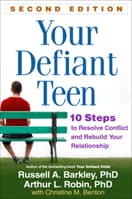
Discover a way to end constant power struggles with your defiant, oppositional, "impossible" 5- to 12-year-old, with the help of leading child psychologist Russell A. Barkley. Dr. Barkley's approach is research based, practical, and doable--and leads to lasting behavior change. Vivid, realistic stories illustrate what the techniques look like in action. Step by step, learn how you can:
Harness the power of positive attention and praise.
Use rewards and incentives effectively.
Stay calm and consistent--even on the worst of days.
Establish a time-out system that works.
Target behavioral issues at home, in school, and in public places.
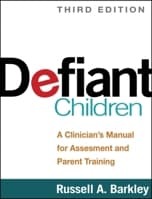
Thoroughly revised to include the latest resources and 15 years' worth of research advances, the second edition also reflects Dr. Barkley's ongoing experiences with parents and kids. Helpful questionnaires and forms can be downloaded and printed in a convenient 8 1/2" x 11" size. Mental health professionals, see also the related title, Defiant Children, Third Edition: A Clinician's Manual for Assessment and Parent Training. For a teen focus, see also Defiant Teens, Second Edition (for professionals), and Your Defiant Teen, Second Edition (for parents), by Russell A. Barkley and Arthur L. Robin. Winner-- Parents' Choice "Approved" Award This description may be from another edition of this product.
I have recommended this book umpteen times. (Don't ask me how many "umpteen" is, but it's a lot!) Realistic, understandable, and well explained. The behavior program is based on positive reinforcement, and from the feedback of my clients, it works! One of my favorite prinicples discussed in the book is "catch your child being good". Barkley is one of the giants in our field, and whatever he writes is golden. Stephanie Moulton Sarkis PhD NCC LMHC Author, ADHD Expert, Psychotherapist
1
★★★★★
Excellent resource for parents
By Thriftbooks.com User, October 5, 2007
My pediatrician recommended this book when I expressed concerns over power struggles I was having with my daughter. Initially I took the book out of the library - then had to buy it because frankly - I can't do without it now.
0
★★★★★
Handle your child with love
By Thriftbooks.com User, May 18, 2005
I read the book in 2001. It has impressed me ever since. I have several books on this subject. I consider this book is the best. The book provides you with the principles and methods to handle a very stubborn kid (but not the kid with a mental disorder). For example, the biggest thing a kid needs is love. But what is love concretely? It is an attention. It is the time that we spend with the kid. But how to spend the time effectively? It is not by controlling him/her. It is by giving him/her the freedom to enjoy the time spent together. I have not followed exactly the methods provided in the book, but the concept has been very useful for me to deal with my child.
0
★★★★★
It really, really helped
By Thriftbooks.com User, June 25, 2002
When my husband got this book we were at our wits' end with our four year old. I was beginning to believe she had no conscience at all. We had a three week wait before we could get in to see the child psychologist. This book helped us understand what was going on, that her behavior wasn't our "fault" but that we were a factor, and that we could actually influence her behavior - which at the time seemed impossible. The process Barkley recommends seemed slow at the time, but looking back, it worked amazingly quickly! We didn't get through all 8 steps; just steps 1-3 made such a difference that we didn't need to. The psychologist we saw, while he hadn't read this book, said it seemed to be very much in line with current clinical practice, and encouraged us to use it. A year and a half later, we do have to go back and make sure we give our child her "special time" (one of the steps) or she slips back into some of her bad habits, but we are actually enjoying being parents now. This is not just a "self-help" type book, though it does give self-tests to help you evaluate your situation. It has a lot of substance, and discusses clinical differences between ADHD, Oppositional Defiance Disorder, and Conduct Disorder in a clear, professional way.
0
★★★★★
Valuable Help for Parents at Their Wit's End .. .
By Thriftbooks.com User, May 11, 2001
The author, eminent in his field and writing from many years of clinical experience and research, has produced a state-of-the-art book on dealing with defiant children. The book is particularly useful in stressing the fundamental importance of taking a positive approach to the child's misbehaviors--focusing on praise and coming up with effective incentives to promote better behavior, rather than continuing with criticism, punishment and the kinds of misguided parental discipline that (with these types of children, at least) serve to worsen both the problem and the child's already impaired self-esteem.The book elaborates on a program that requires a great deal of discipline on the part of the parents to carry out. But it really is "the ticket" for reprograming the child to change behaviors that are both problematic and potentially very serious to his/her healthy development.It's simple enough. All kids adopt and change behavior based on basic principles of reinforcement. This book clarifies just how to reward the behaviors that are wanted and successfully discourage or even eradicate behaviors that are so troublesome. This book should be a "godsend" to parents who have felt totally inadequate to deal with the challenges of such a temperamentally difficult youngster.