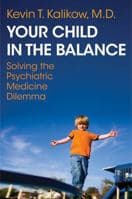
In Your Child in the Balance, child psychiatrist, Kevin Kalikow examines the highly topical and thorny question of whether and when to prescribe psychiatric medication to children. As parents, are we too ready to run to our pediatrician for Ritalin when our child shows the first sign of inattention at school? Or do we instead shy away from our doctor's recommendation to consider an anti-depressant for a chronically sad and withdrawn teenager? Among the ever-growing outcry that psychiatric medicines are over-prescribed to children and adolescents today, how is a parent to know whether medication is the right treatment for their troubled child?
Dr. Kalikow tackles these questions with the sensitivity and insight of years of experience helping families through the thicket of research and opinion to find the right answer for their child. Through many colorful vignettes, he explores our efforts to protect our children from the inevitable hurts and disappointments of childhood, and the role that medication can play in that attempt. On the other side, Kalikow shows us our determination to have our children succeed or fail on their own, the way we had to do, even to the point of refusing the medication that might help them overcome a serious and potentially chronic disability.
Dr. Kalikow guides readers through the maze of possible treatment decisions--the many different families of psychiatric medication, alternative treatments including Cognitive Behavioral Therapy, and perhaps the most difficult decision of no treatment at all. He closes the book by examining one family's difficult journey to the decision to medicate their acutely anxious daughter.
Your Child in the Balance: An Insider's Guide to the Psychiatric Medicine Dilemma is an important and timely book that will hit home to every parent who has seen their child in pain and asked themselves, "I wonder if medication might help." This description may be from another edition of this product.
A Sensitive and Intelligent Guide to a Difficult and Emotional Subject
By Thriftbooks.com User, May 12, 2006
Dealing with a child's illness in any form is always difficult and emotionally draining, but when it comes to less tangible psychological disorders, the acknowledgment of the condition and the subsequent choice of treatment for our children are among the most difficult of all medical issues a parent must deal with. The shift from Freudian therapy to pharmacological treatment of children is new to many of us, and I was admittedly a skeptic and needed a lot of information and understanding. Dr. Kalikow's book was by far the best treatment of any such parenting issue I've ever read. His style of writing - while suffused with an extraordinary amount of well-organized information - is engaging and gentle, and in my case, managed to address almost all of the questions I had on the subject. By presenting scores of individual case vignettes, along with the arguments both for and against various types of treatments, their effects, potential side-effects, time scales, and long-term considerations, Dr. Kalikow's book provided me with a substantial tool with which to deal with problems "in my own back yard." There's a lot of hand-holding in his narratives, and in some cases Dr. Kalikow's easy-going manner may seem like he's addressing an audience of adolescents. But when it comes to handling our children, perhaps we can all benefit from being treated in this way, with a touch on the shoulder and the reassurance that the understanding of these disorders in chldren is still new to everyone, and their treatments are even newer. Bravo and thanks to Dr. Kalikow for providing a very useful and engaging body of information.
0
★★★★★
Very useful guide!
By Thriftbooks.com User, May 10, 2006
I found this book very thought provoking. It provides an unbiased perspective and insight into a very controversial topic.
0
★★★★★
Excellent Book - A Must Read!
By Thriftbooks.com User, May 10, 2006
Ths is a sensitive, thoughtful, informative, intelligently written book authored by a well respected psychiatrist. This book is a must read for anyone involved with the welfare of a child.
0
★★★★★
very helpful to parents
By Thriftbooks.com User, May 10, 2006
A thoughtful and helpful book for a complex subject. Dr. Kalikow addresses the decision making process of the parents, the child and the health care professional when choosing how to address the needs of their child. It is written clearly, with humor, compassion and tenderness. I believe parents will be able to make a more educated decision after reading this book.
0
★★★★★
Helpful book for CSW
By Thriftbooks.com User, May 10, 2006
I have found this book incredibly helpful especially in working with parents who are fearful of putting their kids on medication. I have recommended the book to some of my patients. They felt it was an easy book to read and was helpful to them in deciding whether to put their child on meds or not. I highly recommend this book for both therapists as well as patients. Lori Weinreich