


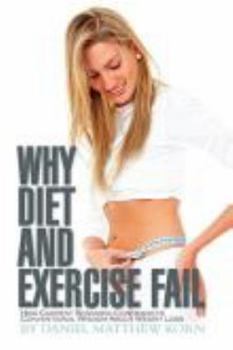
Why Diet and Exercise Fail, Second Edition

We are surrounded by people who are selling weight loss techniques that do not work. Every year Americans spend tens of billions of dollars on diet books, diet products, and gym memberships. In spite... This description may be from another edition of this product.
Format:Paperback
Language:English
ISBN:0615321364
ISBN13:9780615321363
Release Date:January 2009
Publisher:Daniel Korn Books
Length:170 Pages
Weight:0.55 lbs.
Dimensions:9.0" x 0.4" x 6.0"
Customer Reviews
5 ratings
An Eye opener!
Published by Thriftbooks.com User , 16 years ago
I wasn't really expecting an education like this, from such a small book. In fact, I thought the book was going to lead me to a "new" ultimate solution that was going to be pitched, when really most of this is common sense, and boils down to one of the final Section headings. "Eat Healthful Chemical-Free Food". WOW. I was pleasantly surprised at the book and authors' respect for my intelligence by taking a straightforward approach to first debunking the many mysteries and myths surrounding everything from too much pollution to too much soda, as the main contributing factor in our weight-gain and then bringing it home and wrapping it up in a few succinct pages, that point us to a more logical choice of eating more healthful foods, and how our bodies will react to a more healthful diet. This is a quick read, but packs a LOT of information that will make the reader think. Highly recommended.
Great book!
Published by Thriftbooks.com User , 16 years ago
"Why diet and exercise fail" by Daniel Korn examines commonly suspected causes of weight gain and obesity and by process of elimination tries to pinpoint the true cause or main contributers. The book looks at the role of fat, carbs, sugar, inflammation, stress and elevated cortisol, sleep deprivation, prescription drugs, pollution, exercise and activity levels and looks at specific diets including the once semi-popular low carb diet. The conclusion he comes to is similar to what Weston Price found back in the 30's and that is that much ill health and overweight is due at core to a nutrient poor processed foods diet. This tends to cause low energy and other ill effects leading to further damaging compensatory habits like chronic caffeine consumption. Caffeine in particular is singled out due to its cortisol elevating effect and its abililty to interfere with sleep - two factors strongly associated with weight gain and blood sugar issues, though this may not effect everyone equally due to genetic variances. Remedies looked at include quitting caffeine and supplementing with high vitamin E rice bran or wheat germ oil as well as other suggestions. If you have weight or other health issues, you owe it to yourself to check out this book and give the suggestions a trial and see if it can help. A great book!
What really causes obesity
Published by Thriftbooks.com User , 16 years ago
I have read over 50 books on diet and nutrition over the past ten years, and I have to say that Daniel Korn brings together the majority of what I have learned in one book. He discusses the importance of a nutrient dense diet focused on fruits, vegetables, and 100% whole grains. He explains the causes of the imbalance of omega-6 and omega-3 fats and why it is important to seek our meat that comes from animals that are grass fed. He touches on the importance of low insulin levels in your blood so you can tap into your body fat for energy. Also the important reality of inflammation is covered and its causes. He examines what the real results are for different types of diets from low carbohydrate, to low fat, to high fat. He looks at the results of the eating habits of the high fat French, and the ultra high fat Eskimo diet, and why the very high carb Thai diet leads to almost no obesity. These cultures prove that many of our notions are wrong about what causes people to become obese. What really causes obesity? "Stress, hunger, sleep deprivation, and impaired fat metabolism are often over looked predictors of obesity". The Western diet seems to cause obesity when it is exported abroad or adopted by immigrants. "One item in our diet that can cause increases in cortisol production, stress, hunger, inflammation, insulin resistance, blood pressure, blood sugar, and sleep disturbances is caffeine". Caffeine is a poison not a nutrient. It is possible that caffeine could be causing you several symptoms that lead to obesity, and cutting this one item out of your diet could enable you less stress from decreased blood pressure and cortisol being released. You will sleep much better at night, and break the cycle of needing caffeine to function in the morning then it causes you to not be able to sleep well, then you repeat this cycle over and over. If you want to succeed in losing weight permanently then you must focus your diet on nutritious foods that fill you up, there is a big difference in the volume of 700 calories of fast food and 700 calories of fruit as the author points out. Get at least 7 hours of sleep each night. Bring Omega-3 fats into your diet through meats from animals that have been grass fed or free range eggs. Avoid refined carbohydrates like white flour, white bread, and sugar and instead reach for whole foods to keep your blood sugar stable so your body can tap into your stored fat for energy. Stop drinking caffeinated beverages. That is how I lost 60 pounds ten years ago and kept it off and it is what the author also recommends.
Rightsizing America
Published by Thriftbooks.com User , 16 years ago
The author documents the contrast between thin societies like the Eskimos and the Japanese , as opposed to weight gain in the USA. For instance, the Japanese tend to have less heart disease and a better BMI index than Americans. The book mentions that a deficiency of Vitamin B6 may be associated with weight gain. The book goes from one famous theory to another- debunking a plethora of myths. Eating less by dieting, exercise and a whole host of strategies have failed to maintain weight loss permanently in some cases. By the end of the book, the author has narrowed the culprits down to just a few. For instance, bad carbs, heavy coffee and caffeine consumption are cited as factors in weight gain. There are some unknown irritants which may interfere with metabolism like pollution, although the Chinese have a high level of industrial pollutants. This aspect has not contributed to weight gain. It is yet to be seen how the Western junk food impacts the Japanese and Chinese over time. Inflammation foods like high alcohol content, sugar, heavy sauces and junk foods may be the source of metabolic imbalances. This is an area for further research development. The Paleolithic diet of lean meat, fish, nuts, seeds, green veggies and water has been a proven weight maintainer. The Mediterranean Diet has had much success over the junk food diet. I've found that a modified Paleolithic diet has been most helpful in achieving and maintaining permanent weight loss. In my experience, physician advice emphasized diet, caloric restriction , exercise, stress reduction, reduced soda consumption and reduced caffeine consumption. The book reviews some classic diets like the Atkins diet and other strategies for weight loss. Clearly, there is substance to the notion that we must narrow down the causes of weight gain. A methodological process of elimination may produce better answers in our continuing research efforts. The last part of the book discusses continuing research and implications for the future. The book is an excellent acquisition for physicians, dieters, health buffs and the general public.
An Expanded Quest for the Cause(s) of the Obesity Epidemic
Published by Thriftbooks.com User , 16 years ago
Daniel Matthew Korn, the author, was struck by the fact that Israeli youth tend to be slim despite the fact that they ate sweet and fatty foods, and were fairly sedentary. This did not seem to fit current thinking. One notable, and relatively unusual, aspect of the author is his sincere desire to learn from critics, correct his misconceptions, and improve his work. This expanded and deepened second edition surveys many different hypotheses for the massive worldwide increase in obesity in recent decades. Korn surveys not only the usual culprits (fats, excessive calories, sedentary lifestyle, etc.), but also less commonly-cited ones (e. g., pollution, viruses, coffee consumption, stress and cortisol, sleep insufficiency, inflammation-promoting vs. inflammation-reducing foods, etc.). Korn examines low-carb diets in greater detail than he did in his first edition. A shortcoming of his work is the tendency to dwell on isolated studies instead of what the preponderance of evidence shows. Thus, he cites a study which suggests that low-carb and other diets are equally effective for weight loss. Actually, there have now been quite a few studies on this, and most of them show the superiority of the low-carb diet not only for weight loss, but also blood-sugar lowering, etc. Also, low-calorie and even low-fat diets may be successful primarily insofar as they cause a lowering of carb, especially high-glycemic-carb, intake. Every person has a carb-consumption level that he or she can approach without gaining weight. Can we be certain that the Israeli youth take in as many carbs as American youth do? A body-tolerating level of carb intake, especially when these are mostly low-glycemic carbs, could explain the slimness of many Third-World peoples, and that of virtually all peoples before the Industrial Revolution, all despite their carb-centered diets. The search for a cause of modern obesity may be a quixotic one. This owes to the fact that societies change simultaneously in many ways, making the isolation and testing of variables a difficult one. Korn himself repeatedly states that "Correlation is not causation." In addition, variables exist even within specific foods. Consider the lean Thais in spite of their rice-centered diet. Korn suggests the rice bran oil contained in it. Not mentioned is the fact that different forms of rice, even refined rice, have significantly-different glycemic impacts when eaten. We thus have yet another confounding factor. Do low-carb diets often fail, in long term, because overconsumption of refined carbohydrates is not the cause of obesity? Or is it because, once the brain is trained to want an excess of carbs, it is quite difficult for many (though not all) individuals to avoid drifting back to old ways of eating over the span of many years? Why do sugar-free sodas result in weight gain no less than sugary ones? Is it because, as Korn suggests, sugar is relatively irrelevant (perhaps the caffeine is the culprit)? Or is th
Copyright © 2026 Thriftbooks.com Terms of Use
| Privacy Policy | Do Not
Sell/Share My Personal Information | Cookie Policy | Cookie Preferences | Accessibility Statement
ThriftBooks® and the ThriftBooks® logo are registered trademarks of Thrift Books Global, LLC
ThriftBooks® and the ThriftBooks® logo are registered trademarks of Thrift Books Global, LLC
