Skip to content
ISBN: 0262571048
ISBN13: 9780262571043

Using MPI: Portable Parallel Programming with the Message-Passing Interface (Scientific and Engineering Computation)

(Part of the Scientific and Engineering Computation Series)

$8.59List Price: $30.00
Save $21.41!
ISBN: 0262571048
ISBN13: 9780262571043
Formats

Conditions

A read copy, but remains in excellent condition.

Formats

Conditions

A read copy, but remains in excellent condition.

See all 4 editionsfrom $8.29

Book Overview

The thoroughly updated edition of a guide to parallel programming with MPI, reflecting the latest specifications, with many detailed examples.

This book offers a thoroughly updated guide to the MPI (Message-Passing Interface) standard library for writing programs for parallel computers. Since the publication of the previous edition of Using MPI, parallel computing has become mainstream. Today, applications run on computers with millions of processors; multiple processors sharing memory and multicore processors with multiple hardware threads per core are common. The MPI-3 Forum recently brought the MPI standard up to date with respect to developments in hardware capabilities, core language evolution, the needs of applications, and experience gained over the years by vendors, implementers, and users. This third edition of Using MPI reflects these changes in both text and example code.

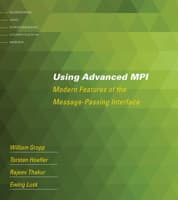
The book takes an informal, tutorial approach, introducing each concept through easy-to-understand examples, including actual code in C and Fortran. Topics include using MPI in simple programs, virtual topologies, MPI datatypes, parallel libraries, and a comparison of MPI with sockets. For the third edition, example code has been brought up to date; applications have been updated; and references reflect the recent attention MPI has received in the literature. A companion volume, Using Advanced MPI, covers more advanced topics, including hybrid programming and coping with large data.

This description may be from another edition of this product.
Format:
Paperback
Language:
English
ISBN:
0262571048
ISBN13:
9780262571043
Publisher:
MIT Press
Length:
307 Pages
Weight:
1.28 lbs.
Dimensions:
9.0″ × 0.8″ × 8.0″
Artificial IntelligenceComputer ScienceComputersComputers & TechnologyData in the EnterpriseEducation & ReferenceHuman Vision & Language SystemsLanguages & ToolsNetworkingParallel Processing ComputersProgrammingSoftware

Customer Reviews

3 customer ratings | 3 reviews
Write a Review

Pretty good for MPI Beginners.

I bought this book for a course on Parallel Computing for which we did some basic MPI programming. This book was useful to a great extent in describing the syntax of the MPI routines as well as in providing ample examples. To my knowledge, it doesn't contain advanced MPI concepts but it is good in explaining the basics of MPI if you are a beginner.

0

Thorough coverage of MPI programming in Fortran, C, and C++

This book is an excellent introduction to programming with the MPI. It gradually introduces concepts from the simple to the complex. This is done with examples that illustrate the use of different techniques. The examples include the code to implement them. The programming examples alternate between Fortran 90, C, and C++. However, after giving the example in one language, the bindings for the MPI functions in the other two languages are presented. In addition, the programming examples in either language are easily understood. Although my first choice of programming language is Fortran (and I have very basic knowledge or C), I was able to follow the examples in C and C++ and to write their equivalents in Fortran so I could test them on our computers.

0

good reference but short on C examples

I liked the reference as an introduction to MPI, but it switched between fortran and C so often that I spent a fair amount of my time just trying to interpret the code samples and synchronize to the syntax of the language they were using. You shouldnt have that problem if you have used Fortran in the last ten years but i havnt touched it since college. You have to be able to work with both languages though because many of the key concepts are only demonstrated in one language. Also the examples were usaully spread out into mini snipets as opposed to a larger block that might show a more complete picture.

0