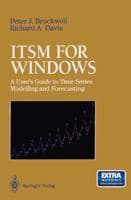
This edition contains a large number of additions and corrections scattered throughout the text, including the incorporation of a new chapter on state-space models. The companion diskette for the IBM PC has expanded into the software package ITSM: An Interactive Time Series Modelling Package for the PC, which includes a manual and can be ordered from Springer-Verlag. * We are indebted to many readers who have used the book and programs and made suggestions for improvements. Unfortunately there is not enough space to acknowledge all who have contributed in this way; however, special mention must be made of our prize-winning fault-finders, Sid Resnick and F. Pukelsheim. Special mention should also be made of Anthony Brockwell, whose advice and support on computing matters was invaluable in the preparation of the new diskettes. We have been fortunate to work on the new edition in the excellent environments provided by the University of Melbourne and Colorado State University. We thank Duane Boes particularly for his support and encouragement throughout, and the Australian Research Council and National Science Foundation for their support of research related to the new material. We are also indebted to Springer-Verlag for their constant support and assistance in preparing the second edition. Fort Collins, Colorado P. J. BROCKWELL November, 1990 R. A. DAVIS * /TSM: An Interactive Time Series Modelling Package for the PC by P. J. Brockwell and R. A. Davis. ISBN: 0-387-97482-2; 1991.
I reviewed this book once before under the pen name statman13. So look at that review to get most of my thoughts about it. I taught times series analysis as a graduate course at UC Santa Barbara many years ago. That was long before this book came out. I used Wayne Fuller's book as a text because it had balanced coverage of time domain and frequency domain approaches. If I were to do it over today I would use Brockwell and Davis' book as it has the right level of theory and also a proper mix of frequency and time domain. I know Richard Davis to be an excellent probabilist and very knowledgeable about stochastic process. I collaborated with him on a paper in extreme value theory. I also had the privilege of refereeing one of his early papers on extreme values that was part of his disseration and was eventually published in the Annals of Probability.
0
★★★★★
Time Series: Theory and Methods
By Thriftbooks.com User, May 25, 2007
Excellent reading. This book covers mainly the frequentist approach to time series analysis in a very informative way. The book starts off by introducing Hilbert spaces, then moves to stationary ARMA processes and so on. My favourite is chapter 10, Inference for the Spectrum of a Stationary Process, in which different tests are considered for periodicities at known and unknown frequencies.
0
★★★★☆
Rigorous, difficult, but feasible
By Thriftbooks.com User, March 28, 2002
Of course, this an advanced textbook on Time Series. The reader is supposed to have been introduced to the subject, and certainly is looking for a more theoretical treatment.If you want to learn time series for the first time, this is not the book.If you want a friendly book, do not see springer's publications.However, if you want a fair rigourous book, you have found it.I think the exercises are illustrative, but sometimes long.