


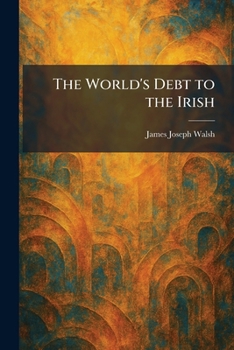
The World's Debt to the Irish

Select Format
Select Condition 
Book Overview
"The World's Debt to the Irish" provides a comprehensive exploration of the profound impact the Irish people have had on Western civilization across several centuries. James J. Walsh examines the rich cultural, intellectual, and spiritual legacy of Ireland, tracing its influence from the early Middle Ages through the modern era. The work highlights the vital role played by Irish missionaries and scholars during the Dark Ages, when Ireland earned its reputation as the "Island of Saints and Scholars."
Walsh delves into various fields where Irish contributions were paramount, including education, literature, art, and the preservation of classical learning. By detailing the establishment of monasteries and universities across Europe, the author illustrates how Irish influence helped shape the foundations of contemporary society. This book serves as an illuminating tribute to the resilience and ingenuity of the Irish spirit, making it an essential read for those interested in Irish history, Celtic studies, and the broader narrative of human progress. It offers a scholarly yet accessible look at how a relatively small island nation left an indelible mark on the global stage.
This work has been selected by scholars as being culturally important, and is part of the knowledge base of civilization as we know it. This work was reproduced from the original artifact, and remains as true to the original work as possible. Therefore, you may see the original copyright references, library stamps (as most of these works have been housed in our most important libraries around the world), and other notations in the work.
This work is in the public domain in the United States of America, and possibly other nations. Within the United States, you may freely copy and distribute this work, as no entity (individual or corporate) has a copyright on the body of the work.
As a reproduction of a historical artifact, this work may contain missing or blurred pages, poor pictures, errant marks, etc. Scholars believe, and we concur, that this work is important enough to be preserved, reproduced, and made generally available to the public. We appreciate your support of the preservation process, and thank you for being an important part of keeping this knowledge alive and relevant.
Customer Reviews
ThriftBooks ® and the ThriftBooks ® logo are registered trademarks of Thrift Books Global, LLC
