


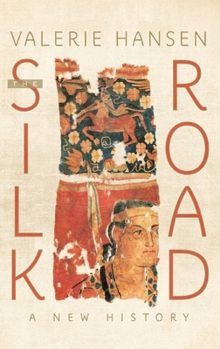
Silk Road C


Select Format
Select Condition 
Book Overview
The Silk Road is as iconic in world history as the Colossus of Rhodes or the Suez Canal. But what was it, exactly? It conjures up a hazy image of a caravan of camels laden with silk on a dusty desert track, reaching from China to Rome. The reality was different--and far more interesting--as revealed in this new history. In The Silk Road, Valerie Hansen describes the remarkable archeological finds that revolutionize our understanding of these trade routes. For centuries, key records remained hidden--sometimes deliberately buried by bureaucrats for safe keeping. But the sands of the Taklamakan Desert have revealed fascinating material, sometimes preserved by illiterate locals who recycled official documents to make insoles for shoes or garments for the dead. Hansen explores seven oases along the road, from Xi'an to Samarkand, where merchants, envoys, pilgrims, and travelers mixed in cosmopolitan communities, tolerant of religions from Buddhism to Zoroastrianism. There was no single, continuous road, but a chain of markets that traded between east and west. China and the Roman Empire had very little direct trade. China's main partners were the peoples of modern-day Iran, whose tombs in China reveal much about their Zoroastrian beliefs. Silk was not the most important good on the road; paper, invented in China before Julius Caesar was born, had a bigger impact in Europe, while metals, spices, and glass were just as important as silk. Perhaps most significant of all was the road's transmission of ideas, technologies, and artistic motifs. The Silk Road is a fascinating story of archeological discovery, cultural transmission, and the intricate chains across Central Asia and China.
Format:Hardcover
Language:English
ISBN:0195159314
ISBN13:9780195159318
Release Date:August 2012
Publisher:Oxford University Press
Length:320 Pages
Weight:1.62 lbs.
Dimensions:1.0" x 6.4" x 9.3"
Related Subjects
Cultural Fiction History Literature & Fiction Social Science Social Sciences TravelCustomer Reviews
2 ratings
A book that proves globalization and cultural diffusion are intrinsically human concepts.
Published by Alex , 17 days ago
The Silk Road was one of the worlds first superhighways. It was a series of roads that linked what is now China to the East Mediterranean. A path that was dotted with multicultural oasis’s that traded exotic tangible and intangible goods.
It is a place layered with centuries of history, where every culture mixed and mingled with Iranians, North Indians, Turkic, Chinese, Mongolic, Hellenic civilizations and everyone in between left their mark. Where religions flourished, philosophy was learned, technology wad traded, languages taught and trends crossed borders.
It truly is a a fantastic aspect of history, and after learning about it it makes since why the amorphous borders of post-classical nations were always trying to get the biggest chunk of the road. It was the lucrative arteries that connected every place that mattered.
The author clearly and concisely described every aspect of the roads history. The main cosmopolitan towns, the military and political importance of the road, the mundane parts of the average citizen, how culture diffused from one place to another, and the priceless artifacts left behind.
It all touches on stuff I enjoy. But frankly I could only rate it 3 stars. The book is a bit too “academic” for lack of a better term. I am a history teacher, so obviously I love history. But when I read non fiction for casual study or enjoyment I prefer my books to be a bit more story like with nice prose and personality. As opposed to just stating facts.
Regardless if you want to learn about the Silk Road, you can’t really go wrong with this. It is a very broad introduction to the Silk Road that covers many concepts and admittedly it can be difficult to find a book that touches on it all. Would I recommend this book for academics, students, and fans of eastern history? Most definitely. However, those with only a passing interest might want to find a different book that dives deeper into a topic or time period adjacent to the Silk Road that interests them.
The ancietn Silk road
Published by Walter KO , 4 years ago
The Silk Road is a fascinating story of archeological discovery, cultural transmission, and the intricate chains across Central Asia and China. Her well research and document the seven cities from Xian China to the West. Readers can envision the traders, envoys, pilgrims and travelers crowded the way which was not a direct route but more than a trader market way. She pointed out there was no direct trade between Rome and China and silk was a precious commodity. Chinese paper to Europe carried a more impact and metal, spices and glass were as important as silk. The freedom of religion was open and respected from Buddhism to Zoroastrianism with shrines, paintings and prayers. Of importance was the Nestorian stone slap on the well documented and celebrated on the first missionary to China in the Tang Dynasty. It is a pleasure to travel with her on the Silk Road thousands of year history and China once again revive the trade and good will along the route to bring mutual benefit, culture and merchandises without monopoly and trade war pf hegemony and colonists and imperialists.
Copyright © 2026 Thriftbooks.com
Terms of Use | Privacy Policy | Do Not Sell/Share My Personal Information | Cookie Policy | Cookie Preferences | Accessibility Statement
ThriftBooks ® and the ThriftBooks ® logo are registered trademarks of Thrift Books Global, LLC
ThriftBooks ® and the ThriftBooks ® logo are registered trademarks of Thrift Books Global, LLC
