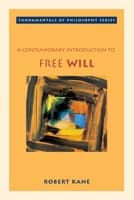
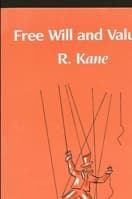
"A magisterial work (that) culminates twenty-five years of thinking about the problems of free will. For those who believe both that robust free will cannot survive in a deterministic climate and that a viable free will need be scientifically respectable, Kane's work may prove salvific." -- Mark Bernstein, University of Texas at San Antonio. In the past quarter-century, there has been a resurgence of interest in philosophical questions about free will. After a clear and broad-reaching survey of these recent debates, Robert Kane presents his own controversial view. Arguing persuasively for a traditional incompatibilist or libertarian conception of free will, Kane demonstrates that such a conception can be made intelligible without appeals to obscure or mysterious forms of agency and thus can be reconciled with a contemporary scientific picture of the world.
Kane Presents the Most Promising Defense of Libertarianism
By Thriftbooks.com User, December 15, 2001
Robert Kane ably defends incompatibilism and proffers his own theory of libertarian agency that avoids the Scylla of noncausalism and the Charybdis of agent-causalism. Kane presents a causal-indeterminist theory of free action that makes use of work in contemporary physics and harmonizes with the dominant theory of action today--viz., the causal theory of action. His theory is compatible with a variety of physicalist theories of the mind and is one of the best candidates out there for a naturalized libertarian theory of free agency. There are drawbacks to his theory, however. Exploiting work in quantum mechanics to defend an incompatibilist theory of free action is not uncontroversial, and Kane seems sensitive to this fact. Overall, however, Kane does a first-rate job of presenting and defending his views while explaining the theories he holds up for criticism. His work reflects a commitment to taking philosophy and science as being on a continuum, but his work never ceases to be an excellent example of how to do conceptual analysis. This volume belongs in the library of anyone doing work in metaphysics and the philosophy of mind and action. It should also be of interest to philosophers of religion, ethicists, and people doing work in moral psychology.
0
★★★★☆
Wonderful except for its politics
By Thriftbooks.com User, June 14, 2001
A superb case for free will, which persuasively draws on recent findings in the sciences. (For a related book, see Ilya Prigogine, "The End of Certainty.") The one shortcoming is the last chapter, where he assumes political libertarianism. It's as if the noble argument of the previous chapters led straight to Texas politics. But the choice he persuasively argues for isn't only individualist; nor is what he scornfully calls "utopia" necessarily totalitarian. Despite this serious flaw at the end, Kane's is an outstanding presentation very rare in academic philosophy. Readers can adapt its arguments to a broader view of freedom that respects and nurtures community and nature.
0
★★★★★
Great book - even if you don't agree with everything said
By Thriftbooks.com User, April 7, 2000
This is a supurbly writen book; it was easy to understand and follow. Not writen for a beginer into philosophy, but even those with a modest introduction to logical thought should have no problem. I don't agree with all of Kane's arguments, but he does a splendid job of bringing the problem out into the open. Read this if you intend to have an inteligent discussion on today's attitudes towards free will.
0
★★★★★
A brilliant exposition of the key issues for free will
By Thriftbooks.com User, January 1, 1999
Kane does a superb job of untangling the confusions about free will, and explaining why and how it is of fundamental importance. We all start by knowing we have freewill but 'clever' philosophers have always tried to bamboozle us into believing that we havent. Kane gives a scrupulously fair summary of the arguments but presents the case for 'incompatablist' free will in an overwhelming and successful manner.Required reading for anyone seriously interested in these matters, which are fundamental to morality, personal identity, love, and everything else that matters.
0
★★★★★
Thorough, civil & knowledgable treatment of this vital topic
By Thriftbooks.com User, September 5, 1998
Kane is meticulous, fair, accessible, and probably right on most aspects of the free will topic. This kind of book is sadly not read outside academe but should be -- in our time when personal responsibility is widely doubted, here is a highly informed defense of it by someone who does not avoid the difficult objections and who does not introduce any mysterious factors to make sense of it. I do not by any means agree with all of what Kane lays out but his discussion has taught me a lot, even where I find him probably wrong. One wishes that other books on the human mind and agency were as level-headed and respectfully (of all sides) written as this work.