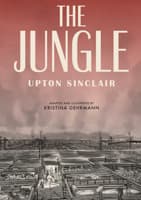
The Jungle (Barnes & Noble Classics Series) (B&N Classics)
Conditions
A read copy, but remains in excellent condition.
Formats
Conditions
A read copy, but remains in excellent condition.
Conditions
A read copy, but remains in excellent condition.
Formats
Conditions
A read copy, but remains in excellent condition.
An ardent activist, champion of political reform, novelist, and progressive journalist, Upton Sinclair is perhaps best known today for The Jungle -- his devastating exposé of the meat-packing industry. A protest novel he privately published in 1906, the book was a shocking revelation of intolerable labor practices and unsanitary working conditions in the Chicago stockyards. It quickly became a bestseller, arousing public sentiment and resulting in such federal legislation as the Pure Food and Drug Act. The brutally grim story of a Slavic family who emigrates to America, The Jungle tells of their rapid and inexorable descent into numbing poverty, moral degradation, and social and economic despair. Vulnerable and isolated, the family of Jurgis Rudkus struggles -- unsuccessfully -- to survive in an urban jungle.
A powerful view of turn-of-the-century poverty, graft, and corruption, this fiercely realistic American classic is still required reading in many history and literature classes. It will continue to haunt readers long after they've finished the last page.
This hyper realistic fiction about the Meatpacking industry in the early 1900’s exposes the gruesome, hidden realities of poverty in Chicago, and the going-on’s of the Meat Packing Industry which could lead you down a rabbit hole that today’s meat packing industry as well as major farming industry still undergo heinous working environments for both the employees and the animals.
Fascinating material. Arrived quickly and in excellent condition. A wonderful book but not for the faint of heart- it is famous for a reason.
Sinclair shows us every aspect of the plight of working class america in the early 1900's. It's easy to focus on his descriptions of the meatpacking industry, and the wrong-doings there, and miss his overall purpose. Sinclair systematically shows how unfettered capitalism destroys and discards good men and women for the purpose of profit, while capitalists live in ungodly luxury. He shows the corruption in politics and policing that benefit those in power. He then predicts the rise of workers revolution and justice that, ultimately, we see crushed in the following years in America. This is a must read.
This is the item I was looking for and reasonably priced.I like the free shipping.
Some years ago I subscribed to the "Biblical Archeology Review" hoping to find out what has been dug up in the Holy Land. What a dissapointment that was. The articles consisted of various scholars spewing venom at each other over their interpretations of archeological history without bothering to show any pictures. The last few reviews of The Jungle are of the same ilk. Give us a break. Sinclair was an unabashed Socialist, but I have yet to hear anyone tell us that he was lying about the conditions in the Chicago stock yards. In what pidgeon hole would you guys place Charles Dickens? He told the truth about living in poverty in England in the 19th century and was a crusader against child labor. Should the same epithets be levied against him? I was raised in an upper middle class WASP environment and had no idea how our beaten down and helpless citizens lived. When I was 17 and 18 I read The Jungle at least five times and was shocked to the point I couldn't sleep. I imagined living that way - helpless, hopeless and exploited to the point of death. It was economic slavery. And those conditions came to exist as the result of the same unbridled greed that resulted in the anti-trust laws, laws protecting workers who dared to form unions and, now, the ruination of our economy at the expense of people who need to rely on others to make a living. Now, 401(k)s are worthless and executives give themselves billions in bonuses from insolvent companies. What's the difference between now and the Chicago meat packing industry in the early 20th century other than the fact that the exploited workers don't come home filthy and odiferous? So what if Sinclair first published his book in serial form in a socialist newspaper? Do you think that Knoph or Harper & Rowe would have picked it up? Sinclair's book is a diatribe against greed and the only way out for workers were unions and unconventional social organizations. Life would be the same today were it not for unions, wage-hour laws and the minimum wage. And the unbridled greed of today will end up affecting the poor and wealty alike. Rather than spend time taking pot-shots at Sinclair, let's think about how the forms of greed he campaigned against have driven our entire country into insolvency.
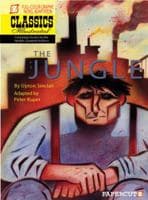
When I read Upton Sinclair's "The Jungle" in high school I had to keep reminding myself that that novel was written in 1906, otherwise I would never be able to eat another hot dog the rest of my life. Although muckraking is a term used to describe journalistic exposes, "The Jungle" functioned much the same way by bringing instant notoriety to the American meatpacking industry. In his story of the Lithuanian immigrant Jurgis Rudkus and his family, Sinclair revealed the unsanitary, dangerous, and inhumane conditions that existed in Chicago's stockyards and meat-packing houses. When the novel was published it became front-page news across the nation and President Theodore Roosevelt invited Sinclair to the White House to discuss his book. Because of this book the sales of pre-packed meat in the United States was cut in half and the public outrage would lead to the passage of both the Pure Food and Drug Act and the Beef Inspection Act. Sinclair's story was first published serially in "The Appeal to Reason," a socialist weekly and was dedicated to "The Workingmen of America." Clearly, Sinclair intended "The Jungle" to be a clarion call to socialism and a plea for the end of wage slavery, and ultimately he was disappointed by the reaction to his novel, writing once, "I aimed at the public's heart and by accident I hit it in the stomach." In this graphic novel adaptation of "The Jungle," artist Peter Kuper and his co-writer Emily Russell (who I believe is his daughter) clearly make an effort to get back to the basics and refocus the story so that this time it hits the heart. Originally published in 1991 as part of an attempt to revive the Classics Illustrated comic book line, Kuper uses a full-color stencil technique that suggests that particular period but anticipates, so to speak, the political art of the period before World War II. Jurgis Rudkus and the other characters are depicted with an almost doll-like quality, which eerily enhances the tragic story. Sometimes I think he looks like a clownish version of the Frankenstein monster, but I find that underscores the sense that Jurgis is up against a man-made monster in the unfettered capitalist economy that Sinclair depicts. To cut down the original novel to the 44-pages illustrated pages of this graphic novel, the mind numbing and health eroding work in the fertilizer plant is reduce to a couple of pages. This is why the focus in Kuper's version shifts from what Americans were eating to what is happening to Jurigs, as his personal tragedy becomes the heart of the story. Consequently, I find that this graphic novel version of "The Jungle" is not so much a substitute for reading the original novel as it is an ancillary work. More than with most such adaptations, you really have to have read (and vividly remember) the original work to appreciate what Kuper and Russell have wrought here. Even if consider socialism to be outdated, unnecessary and/or offensive, you have to admit that Sinclair
Published by Ashly Moore SheldonSeptember 7, 2025
As we welcome the month ahead, we're shining a light on notable and acclaimed September-born authors. We're delighted to celebrate them and their beloved works of fiction, nonfiction, poetry, theater, and more.
Published by William SheltonJanuary 23, 2022
Published by Beth ClarkSeptember 24, 2018
Okay, maybe we can’t eliminate censorship (yet...#goals), but we can celebrate Banned Books Week with gusto by reading all of the stories that someone (or someones) tried to silence, destroy, or restrict access to. Here are 50 of the most frequently banned and/or most recently challenged books, along with the "who, why, and how" of literary censorship in America.