


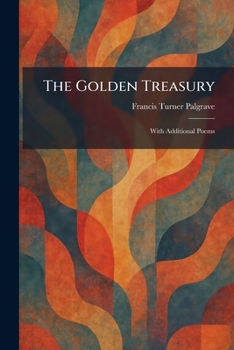
The Golden Treasury: With Additional Poems

"The Golden Treasury" remains one of the most celebrated and influential anthologies of English lyric poetry. Curated by Francis Turner Palgrave, this collection serves as a definitive survey of the finest songs and lyrical poems in the English language, capturing the essence of the poetic tradition from the Elizabethan era through the 19th century.
This comprehensive volume features additional poems that expand upon the foundational selection, offering readers a broader view of the evolution of verse. Within its pages, one finds the masterworks of literary giants such as William Shakespeare, John Milton, William Wordsworth, Percy Bysshe Shelley, and John Keats. Palgrave's meticulous approach was designed to highlight the lyrical beauty and emotional depth of the English language, prioritizing poems that possess an enduring and universal appeal.
As a foundational text for lovers of literature, "The Golden Treasury" has introduced generations of readers to the rich heritage of British verse. It is not merely a collection, but a curated journey through the high-water marks of poetic achievement. This volume continues to be an essential resource for students, scholars, and anyone seeking to experience the transformative power of classic English poetry.
This work has been selected by scholars as being culturally important, and is part of the knowledge base of civilization as we know it. This work was reproduced from the original artifact, and remains as true to the original work as possible. Therefore, you may see the original copyright references, library stamps (as most of these works have been housed in our most important libraries around the world), and other notations in the work.
This work is in the public domain in the United States of America, and possibly other nations. Within the United States, you may freely copy and distribute this work, as no entity (individual or corporate) has a copyright on the body of the work.
As a reproduction of a historical artifact, this work may contain missing or blurred pages, poor pictures, errant marks, etc. Scholars believe, and we concur, that this work is important enough to be preserved, reproduced, and made generally available to the public. We appreciate your support of the preservation process, and thank you for being an important part of keeping this knowledge alive and relevant.
Customer Reviews
ThriftBooks ® and the ThriftBooks ® logo are registered trademarks of Thrift Books Global, LLC
