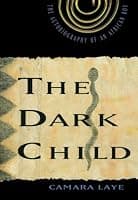
The Dark Child is a distinct and graceful memoir of French author Camara Laye's youth in the village of Koroussa, French Guinea.
Long regarded as Africa's preeminent Francophone novelist, Laye (1928-1980) herein marvels over his mother's supernatural powers, his father's distinction as the village goldsmith, and his own passage into manhood, which is marked by animistic beliefs and bloody rituals of primeval origin. Eventually, he must choose between this unique place and the academic success that lures him to distant cities. More than an autobiography of one boy, this is the universal story of sacred traditions struggling against the encroachment of a modern world.
A passionate and deeply affecting record, The Dark Child is a classic of African literature.
This description may be from another edition of this product.
I am bilingual and have greatly enjoyed this wonderful and captivating, autobiography of the social education of a young boy in Guinee. The author gives considerable understanding to the reader of the customs of Guinee and of the responsibilties of a young boy in that country. The whole book is enthralling and definitely worth reading to understand the African continent.
0
★★★★★
beautiful
By Thriftbooks.com User, July 6, 2001
A beautifully textured, fluid and organic autobiography, Camara Laye offers readers a piece of his life in The Dark Child. As part of the Malinke community in Upper Guinea, Laye captures the layered tradition and culture of his community, deemed, perhaps by most, to be simplistic or primitive compared to today's modern standards. Yet it is exactly from Layes descriptions of the traditions of his community that we can begin to understand the psychology of the author. Each chapter is rich with imagery, and his words smack of sincerity and innocence, bringing about an effortless quality and flow to his work--it is as if we are there with Laye experiencing his many transitions, from boyhood to manhood. His descriptions of the communal lifestyle of his people is remarkable. Laye's works like other modern African authors reveal the realities of colonization, and help readers to appreciate and celebrate indigenous African traditions.
0
★★★★★
Memoir of an African Childhood
By Thriftbooks.com User, November 30, 2000
Camara Laye was one of the first sub-saharan writers to become well-known outside of Africa. "L'Enfant Noir" or "The Dark Child" (also titled "The African Child"?) was published in 1953 when the author was twenty-five and living in France. It is a pleasantly nostalgic memoir of a childhood spent in the town of Kouroussa (French Guinea, now Guinea) and the village of Tindican, his mother's birthplace. Chapter by chapter Camara recounts his childhood memories: his father's work as a goldsmith and his position in society, his parent's magic, village life, the rice harvest, elementary Koranic education, circumcision and young men's secret society, secondary education in Conakry, girls and courtship, and his departure to continue his studies in France. After almost half a century in print, this deserves to be called a classic. [Note: some authorities state that his family name is Camara (also spelled Kamara) and his given name is Laye; the text supports this at one point. If using search engines to look for information on this author it may be useful to try both versions of his name.]
0
★★★★★
Wonderful biography
By Thriftbooks.com User, January 13, 2000
This was a wonderful book. It read very fluently and was more captivating than most biographies. L'Enfant noir is a wonderful example of the movement known as La Negritude, and it is the best French-language book I have ever read.
0
★★★★★
This is the daily life of all African boys in rural area
By Thriftbooks.com User, February 23, 1999
It is amazing how Camara Laye gave an accurate account of the day to day life of all young African boys in this book. Although not from his native Guinee (Conakry), could relate to scenes, stories as if it occured in my own life each time I came into contact with the rural area of my native D. R. of the Congo (either by visiting or from my classmates accounts of their lives in the countryside. Moreover, it recaptures the two cultures standing side by side, the Western and the traditional African as lived and experienced by African boys. The family structure, going to school, playing in the farmes, visits to the city, etc... This is a very powerful testimony of the uniqueness and common shared experiences in the vast and multicolor Africa.