Skip to content
ISBN: 0140511997
ISBN13: 9780140511994

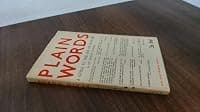
Complete Plain Words 3rd Edition

$5.79
ISBN: 0140511997
ISBN13: 9780140511994
Formats

Conditions

A read copy, but remains in excellent condition.

Formats

Conditions

A read copy, but remains in excellent condition.

See all 31 editionsfrom $4.89

Book Overview

In print since 1948, this style guide has been loved and endorsed throughout the decades by the likes of Bill Bryson, Lynne Truss, David Crystal, Harold Evans, and Winston Churchill

"Be short, be simple, be human." When Sir Ernest Gowers first wrote Plain Words, it was intended simply as a guide to the proper use of English for the Civil Service. Within a year, however, its humor, charm, and authority had made it a bestseller. Since then it has never been out of print. Six decades on, writer Rebecca Gowers has created a new edition of this now-classic work that both revises and celebrates her great-grandfather's original. Plain Words has been updated to reflect numerous changes in English usage, yet Sir Ernest's distinctive, witty voice is undimmed. And his message remains vital: our writing should be as clear and comprehensible as possible, avoiding superfluous words and clich s--from the jargon of "commercialese" to the murky euphemisms of politicians. In a new preface, this edition draws on an extensive private archive, previously hidden away in family cupboards and attics, to tell the story behind a book that has become an institution: the essential guide to making yourself understood. This description may be from another edition of this product.

Format:
Paperback
Language:
English
ISBN:
0140511997
ISBN13:
9780140511994
Release Date:
November 2004
Publisher:
Penguin UK
Length:
304 Pages
Weight:
1.28 lbs.
Dimensions:
7.8″ × 0.7″ × 5.1″
Education & ReferenceForeign Language Study & ReferenceGrammarLanguage ArtsLiteraryLiterary CriticismLiterary Criticism & CollectionsLiterature & FictionReferenceWords, Language & Grammar

More by Ernest A. Gowers

Customer Reviews

2 customer ratings | 2 reviews
Write a Review

AVOIDING CATACHRESIS

`Catachresis' is a simple Greek word meaning `misuse'. If you had never come across it in English before, neither had I until I read it in the second chapter of this book, where it is displayed proudly in the course of a lesson to us on the correct use of the word `jargon'. The first edition of the book appeared in 1948, and it has reappeared in at least 5 revisions and reprints, my own copy dating from 1964. It must have sold well in that case, and while it purports to be trying to teach the British civil service how to write clearly, the author soon forgets this limited aim and treats us to yet another enthusiastic handbook on the proper use of English, a field I had thought well and truly ploughed and reploughed by Fowler, Quiller-Couch, A P Herbert and others. This is how it will have been read by its eager public, and so this is how it should be assessed. Half a century is not nearly long enough for such a work to go out of date, but of course a lot of the interest in reading it today is precisely in seeing how well it has stood the test of so many years, particularly in the age of email. However I found it even more interesting from a sociological viewpoint. `Who's talking?' I kept asking myself. Who feels like pontificating in print on this subject, and why should the rest of us take any notice? We can forget the ostensible objective. Who on earth supposes that the language of the civil service is even trying to be clear much of the time? Whitehall mandarins write memos designed in the main to cover their rear, just as commercial executives do. When clarity is really their aim, it is perfectly compatible with lumpish expression, bad grammar, bad syntax, bad spelling and bad handwriting. The best-crafted English in the world will not make what they say unambiguous in a court of law, as is memorably shown by the story of the use of cleaning-rags `in shops and places other than shops'. You, I and they might have thought that covered all possibilities, but not according to the judge who ruled that a mobile ice-cream tricycle was not a place. This book is really just another guide to good English, for the general public. As such, it is intelligent, balanced, stylish, clear and good-humoured. Gowers is neither pedantic nor unduly tolerant of shoddy writing. He understands that a language is a living thing, and he does his best to judge which neologisms are part of the organic development of the language and which are pimples and warts that could do with removing. Any educated reader with an ear for the language and a love of the language could probably do as well as he does, and I wonder what he would have made of the use of `rendition' in 2005. I feel he is wasting his breath with his complaints about philosophers' idiom at the start of chapter 8 - philosophers have to write they way they do, just as lawyers have to. Checking his tastes against my own, I find us largely in agreement. I shall go to my final reckoning innocent of using `anticipa

0

Though published decades ago,still relevant/useful

This book was originally written for bureaucrats so that they might better communicate officialese. Yet it really goes further: it can be used, appreciated, by anyone wishing to improve or confirm their knowledge of written English. Gowers writes in compact, sometimes dryly humourous, style, as he corrects the often confused use of "which-that" and "who-whom", the employment or negligence of the subjunctive, and punctuation. It's an enjoyable,educative work relevant to today, with the English language changing and, perhaps, degrading.

0