


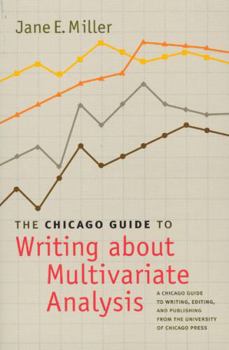
The Chicago Guide to Writing about Multivariate Analysis (Chicago Guides to Writing, Editing, and Publishing)

Select Format
Select Condition 
Book Overview
Writing about multivariate analysis is a surprisingly common task. Researchers use these advanced statistical techniques to examine relationships among multiple variables, such as exercise, diet, and heart disease, or to forecast information such as future interest rates or unemployment. Many different people, from social scientists to government agencies to business professionals, depend on the results of multivariate models to inform their decisions. At the same time, many researchers have trouble communicating the purpose and findings of these models. Too often, explanations become bogged down in statistical jargon and technical details, and audiences are left struggling to make sense of both the numbers and their interpretation. Here, Jane Miller offers much-needed help to academic researchers as well as to analysts who write for general audiences. The Chicago Guide to Writing about Multivariate Analysis brings together advanced statistical methods with good expository writing. Starting with twelve core principles for writing about numbers, Miller goes on to discuss how to use tables, charts, examples, and analogies to write a clear, compelling argument using multivariate results as evidence. Writers will repeatedly look to this book for guidance on how to express their ideas in scientific papers, grant proposals, speeches, issue briefs, chartbooks, posters, and other documents. Communicating with multivariate models need never appear so complicated again.
Format:Paperback
Language:English
ISBN:0226527832
ISBN13:9780226527833
Release Date:August 2005
Publisher:University of Chicago Press
Length:500 Pages
Weight:1.30 lbs.
Dimensions:8.0" x 0.8" x 5.3"
Customer Reviews
2 ratings
A GREAT resource for social scientists and curious students
Published by Thriftbooks.com User , 19 years ago
This is one of the best compact resources for understanding how to think about data, and how to communicate meaning derived from data to a non-scientific audience. While not a data presentation tool exactly (I recommend Walgren et al, "Graphing Statistics and Data") it does suggest the importance of critical thinking about data. A must!
A good tool
Published by Thriftbooks.com User , 20 years ago
The book is very useful. The only problem is partial overlapping with The Chicago Guide to Writing about Numbers, by the same author. If you don't own the other one, buy just this one.
Copyright © 2026 Thriftbooks.com
Terms of Use | Privacy Policy | Do Not Sell/Share My Personal Information | Cookie Policy | Cookie Preferences | Accessibility Statement
ThriftBooks ® and the ThriftBooks ® logo are registered trademarks of Thrift Books Global, LLC
ThriftBooks ® and the ThriftBooks ® logo are registered trademarks of Thrift Books Global, LLC
