


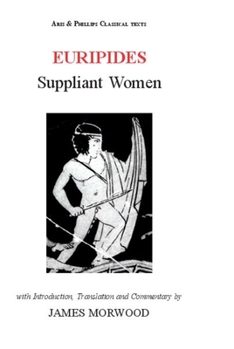
Euripides: Suppliant Women


Select Format
Select Condition 
Book Overview
A group of Argive women has come to Eleusis to ask King Theseus and his city of Athens to bring about the burial of their sons who are being denied it by their Theban conquerors. Theseus is confronted with a challenge which at first he declines to take up, but then does so magnificently. The range of the play's debate is astonishing. It contains one of the Ur-texts of political theory. It explores social and religious themes. It deals with the concept of a just war, with the family, and with the role and behaviour of women. Above all it sets before us the education of Theseus, showing us movingly how this great hero is transformed into a great man. Greek text with facing translation, introduction and commentary.
Format:Paperback
Language:English
ISBN:0856687847
ISBN13:9780856687846
Release Date:December 2006
Publisher:Liverpool University Press
Length:268 Pages
Weight:0.81 lbs.
Dimensions:0.8" x 5.8" x 8.3"
Customer Reviews
1 rating
Compassion for the dead and the folly of war.
Published by Thriftbooks.com User , 27 years ago
The suppliants in this play by Euripides are seven women and their king (Adrastus, King of Argos) who have come to Athens and its leader, Theseus, to ask for aid in their quest. The women's seven sons had been killed in battle against Thebes in the attempt by Polyneices to regain his inheritance from his brother Eteocles (both sons of Oedipus). Argos lost the battle and both of the sons of Oedipus were killed. The new ruler of Thebes, Creon (the brothers' uncle), refused the mothers the right to recover their sons' bodies for burial. Theseus, at first, refuses to help them since it was Adrastus's folly to get involved in that war; however, Theseus is persuaded by his own mother. This is another of Euripides's "irony" plays in which he points out the folly of war, particularly wars whose origins are long in the past (such as the war Athens was currently involved with Sparta).
Copyright © 2026 Thriftbooks.com
Terms of Use | Privacy Policy | Do Not Sell/Share My Personal Information | Cookie Notice | Cookie Preferences | Accessibility Statement
ThriftBooks ® and the ThriftBooks ® logo are registered trademarks of Thrift Books Global, LLC
ThriftBooks ® and the ThriftBooks ® logo are registered trademarks of Thrift Books Global, LLC
