


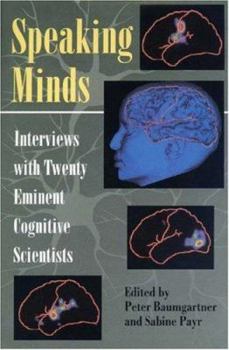
Speaking Minds: Interviews With Twenty Eminent Cognitive Scientists (Princeton Legacy Library, 292)

Few developments in the intellectual life of the past quarter-century have provoked more controversy than the attempt to engineer human-like intelligence by artificial means. Born of computer science, this effort has sparked a continuing debate among the psychologists, neuroscientists, philosophers, and linguists who have pioneered--and criticized--artificial intelligence. Are there general principles, as some computer scientists had originally hoped, that would fully describe the activity of both animal and machine minds, just as aerodynamics accounts for the flight of birds and airplanes? In the twenty substantial interviews published here, leading researchers address this and other vexing questions in the field of cognitive science. The interviewees include Patricia Smith Churchland (Take It Apart and See How It Runs), Paul M. Churchland (Neural Networks and Commonsense), Aaron V. Cicourel (Cognition and Cultural Belief), Daniel C. Dennett (In Defense of AI), Hubert L. Dreyfus (Cognitivism Abandoned), Jerry A. Fodor (The Folly of Simulation), John Haugeland (Farewell to GOFAI?), George Lakoff (Embodied Minds and Meanings), James L. McClelland (Toward a Pragmatic Connectionism), Allen Newell (The Serial Imperative), Stephen E. Palmer (Gestalt Psychology Redux), Hilary Putnam (Against the New Associationism), David E. Rumelhart (From Searching to Seeing), John R. Searle (Ontology Is the Question), Terrence J. Sejnowski (The Hardware Really Matters), Herbert A. Simon (Technology Is Not the Problem), Joseph Weizenbaum (The Myth of the Last Metaphor), Robert Wilensky (Why Play the Philosophy Game?), Terry A.Winograd (Computers and Social Values), and Lotfi A. Zadeh (The Albatross of Classical Logic). Speaking Minds can complement more traditional textbooks but can also stand alone as an introduction to the field. Originally published in 1995. The Princeton Legacy Library uses the latest print-on-demand technology to again make available previously out-of-print books from the distinguished backlist of Princeton University Press. These editions preserve the original texts of these important books while presenting them in durable paperback and hardcover editions. The goal of the Princeton Legacy Library is to vastly increase access to the rich scholarly heritage found in the thousands of books published by Princeton University Press since its founding in 1905.
Format:Hardcover
Language:English
ISBN:0691036780
ISBN13:9780691036786
Release Date:April 1995
Publisher:Princeton University Press
Length:376 Pages
Weight:1.38 lbs.
Dimensions:9.5" x 1.0" x 6.3"
Customer Reviews
2 ratings
Excellent Perspective of Cognitive Science
Published by Thriftbooks.com User , 18 years ago
Overall - Excellent Read! For a little background, I used this book as an introduction to cognitive science as part of an undergraduate, self-study, artificial intelligence course. As a result of this book, I now have a greater appreciation for what AI is, I know why it is generally looked down upon by those outside of the field, and I still got a good overview of cognitive science. While this book is a little dated (the interviewees talk a lot about connectionism), it is an excellent way to understand the history of AI and cognitive science. It is also quite nice to see some of the participants criticize each other presenting two side to an argument (particularly Dreyfus and Newell on the progress & future of AI). As a result of this book, I have a much better appreciation for cognitive scientists in general and AI researchers specifically. I think this should be on the short list for any aspiring AI researcher.
well done
Published by Thriftbooks.com User , 28 years ago
It was an thoroughly interesting read. The book touches on everything cog sci.
Copyright © 2026 Thriftbooks.com
Terms of Use | Privacy Policy | Do Not Sell/Share My Personal Information | Cookie Policy | Cookie Preferences | Accessibility Statement
ThriftBooks ® and the ThriftBooks ® logo are registered trademarks of Thrift Books Global, LLC
ThriftBooks ® and the ThriftBooks ® logo are registered trademarks of Thrift Books Global, LLC
