


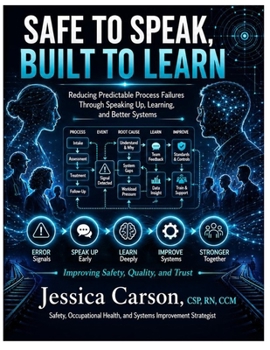
Safe to Speak - Built to Learn: Reducing Predictable Failures by Building Systems That Learn, Not Blame

Safe to Speak, Built to Learn is a professional leadership guide and toolkit for reducing predictable process failures by building stronger speak-up systems, better learning routines, and more reliable operations.
Most organizations tell people to "be more careful," "follow the process," or "speak up sooner." But repeated mistakes usually do not come from one careless person. They come from weak signals, unclear standards, workarounds, pressure, silence, fragmented systems, missed handoffs, poor feedback loops, and corrective actions that do not actually fix the pattern.
This book helps leaders see those signals earlier.
It shows why workarounds are often operational intelligence, why psychological safety is not lowered accountability, why repeated errors deserve pattern recognition, and why leaders need better systems for hearing the truth before small problems become expensive failures.
Inside, you get 23 practical tools for reviewing risk signals, identifying repeat patterns, improving corrective actions, strengthening standards, closing the loop, running learning huddles, and building a practical learning culture operating system.
This is not a short ebook or general leadership pamphlet. It is a full professional guide for supervisors, managers, safety leaders, HR leaders, operations leaders, quality professionals, continuous improvement teams, and executives who manage real operational, safety, quality, compliance, and people-risk problems.
The value is practical. One repeated documentation error, missed handoff, unclear rule, preventable rework cycle, unreported near miss, or avoidable turnover event can cost far more than the price of this guide. These tools are designed to help leaders identify those patterns earlier, reduce repeat failure, improve reporting, strengthen standards, and build better systems before problems become more expensive.
Use this guide to support leadership development, safety culture improvement, process review, corrective action improvement, near-miss learning, team huddles, quality improvement, and internal continuous improvement conversations.
Inside this guide, you will learn how to:
Identify the difference between isolated mistakes and repeated system signals.
Recognize when volume, interruptions, manual work, unclear standards, and fragmented systems make error predictable.
Use workarounds as operational intelligence instead of ignoring or punishing them.
Build psychological safety as access to truth, not as lowered standards.
Conduct better conversations after mistakes, concerns, near misses, and rule confusion.
Strengthen standards by testing whether they are clear, usable, current, trained, and supported.
Turn repeated errors into pattern recognition, corrective action, and verified learning.
Connect learning culture to measurable business value.
Build a practical learning culture operating system using tools, huddles, dashboards, and leadership routines.
Best for: supervisors, managers, safety leaders, HR leaders, operations leaders, quality professionals, continuous improvement professionals, executives, and organizations that want fewer repeat failures, stronger accountability, better reporting, and smarter learning systems.
Customer Reviews
ThriftBooks ® and the ThriftBooks ® logo are registered trademarks of Thrift Books Global, LLC
