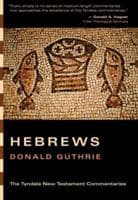
"The book of Revelation is, I fear, a very neglected book. Its symbolism belongs to the first century, not to our own age," says Leon Morris in the preface to his commentary on Revelation.Here he explains the significance of the symbolism and shows the bearing of the message of Revelation on the problems of the day in which it was written.The original, unrevised text of this volume has been completely retypeset and printed in a larger, more attractive format with the new cover design for the series.The Tyndale New Testament Commentaries have long been a trusted resource for Bible study. Written by some of the world's most distinguished evangelical scholars, these twenty volumes offer clear, reliable, and relevant explanations of every book in the New Testament.These Tyndale volumes are designed to help readers understand what the Bible actually says and what it means. The introduction to each volume gives a concise but thorough description of the authorship, date, and historical background of the biblical book under consideration. The commentary itself examines the text section by section, drawing out its main themes. It also comments on individual verses and deals with problems of interpretation. The aim throughout is to get at the true meaning of the Bible and to make its message plain to readers today. This description may be from another edition of this product.
I've used this commentary for my Sunday School class and it's received good feedback from laypeople who want a brief and clearly written exposition of Revelation. Leon Morris adopts a non-dispensationalist viewpoint in his commentary. It was hard to discern whether he was amillennial or historical premillennial. He believes that Rev. 20 describes the reign of the martyrs rather than the reign of all the saints. A very interesting perspective. In any case, he interprets the 144,000 and the great multitude in Revelation 7 as representing spiritual Israel (the church) rather than literal Israel. Here are some of my assessments of this commentary. Good points: 1) It is easy to read and the explanations are clear 2) Morris provides an excellent outline of the whole book of Revelation 3) Morris reminds the reader that we need to adopt a humble and open-mind when reading the book of Revelation Weak points: 1) Explanations are too brief or vague at points. Examples: "hidden manna" (Rev. 2: 17) -- Morris is somewhat ambiguous in his explanation of what exactly it is; "white stone" (2:17) -- Morris offers different suggestions on what it could mean and concludes "we simply do not know what the white stone signified, though clearly it did convey some assurance of blessing"; it is frustrating to read a commentary when the commentator says "we don't really know what this means." It is honest but not very helpful! (it is better for Morris to make a decision on what he sees as the most likely explanation) 2) Insufficient explanation for why certain things should be interpreted Example: Morris states that the "Two Witnesses" in Rev. 11: 1-14 should be interpreted symbolically rather than literally. He states that "difficulties multiply" when one takes the "Two Witnesses" literally. What difficulties? To me, the symbolic interpretation of the "Two Witnesses" as representing the church has more difficulties than the literal interpretation. How does one interpret the dead bodies lying in the street if the two witnesses represent the church? How does one interpret the 3 1/2 days, and then the witnesses being caught up to God? Yes, chapter 11 is one of the most difficult chapters in Revelation to interpret. I was expecting Morris to do a more complete job of explaining his interpretation, but he didn't do an adequate job in explaining his reasons for interpretation other than giving blanket statements. 3) Morris should clearly state what his position is. For example, in the introduction of the commentary, he explains 4 different approaches in interpreting Revelation (preterist, historicist, idealist, and futurist). He states that one should incorporate several of these approaches and not just one approach. Yet, Morris fails to tell the reader which approaches he adopts. I noticed this throughout the commentary; Morris sometimes would present different options or suggestions on what a phrase or passage means, and then would no
1
★★★★★
Great Commentary
By Thriftbooks.com User, March 29, 2000
If you are interested in getting a commentary that is the result of a lot of top level scholarly work, but don't want alot of the way advanced technical terminology, this is a good book for you. Don't get me wrong, nothing is watered down or made simple. It is still very scholarly and detailed, but it is understandable. The whole Tyndale series is an excellent buy.