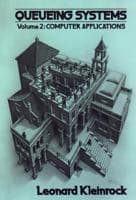
This was assigned for my Computer Modeling class after a hiatus away from classes and advanced math. Talk about a shell shock! This is a book of theory, and treats itself as such. You'll see pages upon pages of formulas, abstract designs, and altogether nasty proofs. A strong background in math and probability is a must. This book is old, and few would consider a Computer Science book written in the 1970's to ber of much value today. True, some of the more modern advances are not here, but the classical methods are done and explained so well that's there's still much to gain by reading it.
0
★★★★★
Still up to date
By Thriftbooks.com User, December 9, 2006
Since this book was published in 1975, and since queueing theory has expanded enormously since then, one might think that this book (Queueing Systems, Volume 1) would be hopelessly out of date. It's not! Of course, no method developed after 1975 is included. But, if one is learning queueing, this book is still essential reading. Some of the topics are not well presented anywhere else, and other topics receive a presentation that is very special. This is a terrific book to learn from. The author's writing style is friendly and the choice of topics is excellent. This is an ESSENTIAL book for any queueing theory library.
0
★★★★★
A Queuing Theory text you can easily follow
By Thriftbooks.com User, July 18, 2000
This is the most easy to follow yet comprehensive book on queuing theory I have seen. I read it cover to cover - most unusual for a mathematical text book. It fully explains the concepts it develops step-by-step and gave me a full enough understanding to develop the analyses I needed for my own research on computer networks - moreso than any other reference I have used.
0
★★★★★
*THE* Book for Queuing Theory
By Thriftbooks.com User, March 28, 2000
Leonard Kleinrock's "Queuing Systems", is *THE* book for any person interested in Queuing Theory. However, the reader should have a working knowledge of probability theory to be able to exploit this book fully. The theory is presented in an easily comprehensible form, and derivations of results are present in good mathematical detail. This book is widely referred to, in many technical publications.