ISBN: 0861632230
ISBN13: 9780861632237
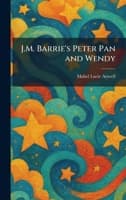
Peter Pan and Wendy
ISBN: 0861632230
ISBN13: 9780861632237
Formats
Conditions
Formats
Conditions
Conditions
Formats
Conditions
This work has been selected by scholars as being culturally important and is part of the knowledge base of civilization as we know it.
This work is in the public domain in the United States of America, and possibly other nations. Within the United States, you may freely copy and distribute this work, as no entity (individual or corporate) has a copyright on the body of the work.
Scholars believe, and we concur, that this work is important enough to be preserved, reproduced, and made generally available to the public. To ensure a quality reading experience, this work has been proofread and republished using a format that seamlessly blends the original graphical elements with text in an easy-to-read typeface.
We appreciate your support of the preservation process, and thank you for being an important part of keeping this knowledge alive and relevant.
This description may be from another edition of this product.J.M. Barrie entitled his book "Peter Pan and Wendy" because it was not only about the boy who never grew up but also about the girl who indulged him in his childishness. The relationship between the two children was apparently intended to be a sarcastic parody on the relationship between the immature father - Mr Darling -and the syrupy mother. We all recognize the character of the man who won't grow up and many women sigh and say, "I have three children - and my husband makes four." However what is not so obvious is that many women partly encourage their men to stay in this emotionally crippled role. For instance, there is the strange habit of women washing men's clothes for them. Anyone who can't operate a washing machine shouldn't be let loose in the family car but women persist in treating men as if they are incapable of organising their personal belongings and men cooperate in this. The husband of a friend of mine will say to his wife, "I don't know where my red jumper is." She puts aside the highly intellectual work she's doing, goes to the cupboard and says, "There's your red jumper - under the green one where I put it (after I washed and dried it)" They have a very happy marriage - unlike my own where I refused to do that sort of thing. I think the reality is that people feel good being treated as a baby some of the time. Men like being fussed over and having unnecessary things done for them. Women like to feel protected, at least some of the time. Both sexes like to act childishly at times, the classic behaviour of adults feeding each other food off their own spoons being a very obvious sign of two people falling in love. It seems that Barrie touched on something that runs quite deep through adult romances. What is interesting is that children don't notice any of that nor the rather snide and sarcastic way that Barrie regards the whole issue. Instead they love the magic of the imaginary island and the idea of being able to fly and all the wild and woolly characters. They love the fun of it all and they ignore the issues of who should grow up and when. Good on them, I say!