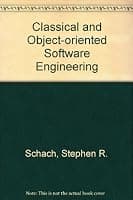
Object-Oriented and Classical Software Engineering
Conditions
An apparently unread copy in perfect condition.
Formats
Conditions
An apparently unread copy in perfect condition.
Conditions
An apparently unread copy in perfect condition.
Formats
Conditions
An apparently unread copy in perfect condition.
Integrating case studies to show the object oriented approach to software engineering, Object-Oriented and Classical Software Engineering, 8/e presents an excellent introduction to software engineering fundamentals, covering both traditional and object-oriented techniques.
While maintaining a unique organization with Part I covering underlying software engineering theory, and Part II presenting the more practical life cycle, the eighth edition includes significant revision to problems, new content, as well as a new chapter to enable instructors to better-utilize the book in a one-semester course. Complementing this well-balanced approach is the straightforward, student-friendly writing style, through which difficult concepts are presented in a clear, understandable manner. This description may be from another edition of this product.
This book detailed the different methods of attacking software design and introduces UML diagrams, statecharts, and organization. A wonderful book for those who will be working in the field dealing with the structure and methods that real business' use for software design.
I had to buy this for my software engineering course at school, and I have found it very useful in explaining software design models and reqs and spec documentation. What I didn't expect were great anecdotes and the chapters on coding practices improved my code-writing skills more than any other source. I also like the fact that the author strayed away from language-specifics, relying more on the theory and design than the actual impementation.
I took Professor Schach's course with the last edition of this book two years ago, and it has been very useful for me now that I work at a big corporation. It is a common misconception to think of it as a UML or OOP programming book, because many people confuse software engineering with the areas of software development and programming. They are quite different. This book is best aimed at programmers that want to understand the processes that exist for writing well-planned code in a large organizations. Think of this book as focusing on the overarching _process_ of writing software. This is especially important from the perspective of a project leader or a manager in a software company. It also offers important business perspectives for software development that you should be aware of. If you want to understand why your customers are unhappy with your results, why things are over budget, or why your project keeps missing deadlines, for example. There's alot more in there as well. I really liked it, and Schach knows what he's doing. He owns a software consulting company if I remember correctly.
It is one of the best book that i have read :)