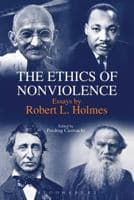
"This Second Edition adds twenty-three new readings to a collection of writings by some of the leading theorists and practitioners of nonviolence. Holmes and Gan provide a diversity of articles on both secular and religious origins of nonviolence; articles by or about Gandhi, King, Tolstoy, and Chavez; feminist approaches to nonviolence by contemporary writers; new articles addressing the theory and practice of nonviolence with respect to nature and animal rights; and fresh examples of the application of nonviolence to conflicts in the Middle East, Europe, Africa, and Tibet. The collection includes the perspectives of those committed to nonviolence as a principle, those committed to nonviolence primarily as a tactic, and those for whom nonviolence is a personal practice."--BOOK JACKET. This description may be from another edition of this product.
More of a text than anything, this book serves as a good introduction to the various forms and roots of nonviolent philosophies. From ancient Jainism to modern peace writers, this will make a great basic reference for anyone, complete with sample writings and a few examples of nonviolence theories in action. If you're looking for depth, this won't give you any, but it is sure to enlighten and broaden your knowledge on the various theories and their presentation and after reading this you will have a good knowledge base to work from.
0
★★★★☆
An incredibly good introduction
By Thriftbooks.com User, May 8, 2002
Robert Holmes has put together a wonderful collection of essays on the topic of nonviolence. Topics range from religious and philosophical foundations, to the nonviolent philosophies of Gandhi, Tolstoy, and King, Jr., to women and violence, pacifism, and case studies. The whole is prefaced by a very good Introduction in which Holmes analyzes the different meanings of "nonviolence," and is ended with a decent bibliography of relevant works on nonviolence.For the beginner, Holmes' anthology admirably makes three essential points about nonviolence: first, pacifism is one form of nonviolence, but is not identical to nonviolence; second, nonviolence isn't merely abstinence from physical violence; third, violence is not the same as force. Nonviolent resistance, for example, is clearly an exercise of force. Keeping points such as these in mind constitutes a good counterweight to the conventional assumption that proponents of nonviolence are quietistic, passive types who suffer any and all injustice.If I have any reservations about this excellent collection, it's that Holmes doesn't do justice to the religious foundations of nonviolence, particularly when it comes to Christianity and Buddhism. Moreover, his inclusion of parts of Thoreau's "Civil Disobedience" is rather perplexing. Thoreau (as Holmes admits) was not an advocate of nonviolence.Still, no book can do everything, and this one does much. Highly recommended.
0
★★★★★
great intro to political/military philosophy
By Thriftbooks.com User, March 24, 2000
This is a wonderful textbook for any course in the history or philosophy of nonviolence. Not only is it a complete overview of the history or nonviolence, but it includes some very unexpected contributors, in addition to the obvious. one of the most remarkable theories presented is an essay by A.A. Milne, more popularly known for his winnie the pooh books than for serious philosophical theorizing. and his proposed solution to war is so gloriously simple! He makes brilliant metaphors concerning war as a poison or a medicine, and a brilliant domestic analogy, but really, read the whole thing for yourself.