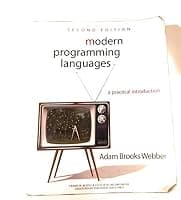
Intended for computer science majors, this textbook introduces the abstract concepts that underlie all programming languages, and provides tutorials on ML, Java, and Prolog. Webber (University of Wisconsin) explains the grammar that defines syntax and semantics, language systems, types, polymorphism This description may be from another edition of this product.
Excellent Book on learning Basic Computer Languages.
By Thriftbooks.com User, September 29, 2006
This is a great textbook for people wanting to learn the basics of programming computers.It logically presents ML,Java and Prolog.The first sentence states,"Computer programmes are practical magic.".It absolutely is ! You will enjoy reading the historical background on programming too.The ideas really are not difficult to fathom .If you have a desire to learn the foundations of computer language design.For an advanced computer student,this book will be repetitive and frivolous.Yet,i found this basic programming book to be enjoyable and insightful.
0
★★★★★
Excellent coverage of ML, Java, Prolog, and PL theory
By Thriftbooks.com User, April 3, 2005
This is one of the most clear and enjoyable Computer Science books I have ever read -- and being a CS Ph.D. student I've read quite a lot! The examples are at the right level of complexity, and the exercises at the end of each chapter are actually (gasp) fun! Alternating theoretical and practical chapters makes for a very balanced reading, where abstract concepts are explained by linking them to real language features. The book smoothly moves the reader through Standard ML, Java and Prolog in a concise and pleasant manner. Although it doesn't go deep in any of these languages, it provides the reader with enough background to create simple programs and utilize the power of each language; the interested reader can go on to learn advanced language features with the confidence that all the basics have been covered. The book draws clear distinctions between all three languages, each of which represents a different way of thinking about programming. If you are looking for an excellent book on programming languages, or you just want to get a feel about different programming paradigms, this is your book!
0
★★★★★
A gentle Programming Languages text w/ functional languages
By Thriftbooks.com User, May 7, 2004
I just finished using this book teaching our Programming Languages course. We easily covered the entire book in a 15 week semester while adding additional material on Formal Semantics and Concurrent Programming. I really loved the book; the writing was engaging (I'm not kidding, this is the best textbook I've ever seen) and the supporting materials were extremely helpful. The greater-than-usual attention to functional programming languages (Webber covers ML, Java and Prolog) was initially the most important feature for me.The only possible complaint about the text is that it doesn't go into more detail on a number of topics. The next time I teach the class, I would be happy to use it again while providing supplemental material, although I am considering Friedman et al's Essentials of Programming Languages.