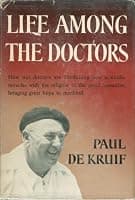
"It manages to delight, and frequently to entrance, old and new readers and] continues to engage our hearts and minds today with an indescribably brand of affectionate sympathy."--F. Gonzalez-Crussi, from the Introduction An international bestseller, translated into eighteen languages, Paul de Kruif's classic account of the first scientists to see and learn about the microscopic world continues to fascinate new readers. This is a timeless dramatization of the scientists, bacteriologists, doctors, and medical technicians who discovered the microbes and invented the vaccines to counter them. De Kruif writes about how seemingly simple but really fundamental discovers of science--for instance, how a microbe was first viewed in a clear drop of rain water, and when, for the first time, Louis Pasteur discovered that a simple vaccine could save a man from the ravages of rabies by attacking the microbes that cause it.
I read this book as a child and it was fascinating reading. Some of what is described is still current (Pasteur's rabies vaccine) while some treatments are long out of use (Ehrlich's "magic bullet" for syphillis was actually derived from arsenic and had a fair amount of side effects-an accurate cure would not be developed until the discovery of Penicillin). Also some of the attitudes taken by the writer are racist such as the quip along the lines that "you couldn't tell the Africans with sleeping sickness apart from the healthy ones because they were all lazy". This should remind people of the dichotomy that existed in society then. Also biology then was like a manic gold rush. There were no restrictions on testing medicenes so that famous scientific figures would test the treatments on friends, family or if they were brave, themselves. One thing that was strongly prevalent then was the optimism of a cure for the various diseases. There was no sense of a pharmeceutical industry trying to quickly bring to market a highly profitable drug, whether or not it was safe or effective or even more than slightly different from other medications. There was no sense of cynicism then. Once the germ theory was developed, people realized what lived amidst their world and sought to find ways to have people live better and healthier lives. So you can dismiss some of the outdated attitudes and ideology and see this book as specimen on a microscope slide, frozen in time, to be examined from a new perspective
0
★★★★★
Ripping good stories, better than any fiction
By Thriftbooks.com User, November 2, 2001
Wonderful book, lively prose, vivid descriptions of the dawn of modern medicine as it was developed in army hospitals, jungles, swamps, and cramped attic "laboratories." And lines like "... the fundemental sadness of Pasteur's life, ....the crown of thorns that madmen wear whose dream it is to change a world in the little seventy years they are allowed to live."Too bad descriptions of blacks as "darkies" (1924) will keep this book out of the hands of some kids. But come on, these scientists risked their lives and very often died trying to cure the sick in Africa. So can we can cut them a little slack for not being as gloriously enlightened as us, even if they were infintely braver ?People familiar with biethics or medicine will see a world where many ethical questions that had not been defined. For instance, informed consent and double blind trials were hardly known - almost *none* of the experimental treatments could be done legally today, even though the researchers often used themselves as subjects and died.
2
★★★★★
Microbe Hunters
By Thriftbooks.com User, August 28, 2000
Well written history of the earliest researchers and explorers of the microscopic world. The author provides histories that reveial the human side of these early explorers; the science is non technical so the lay person can easily follow in the foot steps of these pioners. DeKruif writes with passion and humor making this an enjoyable and informative read. Although the book was first published more than 50 years ago, it is an excellent and relevant history. I strongly recommend it to anyone with an interest in the history of science.
2
★★★★★
Microbe Hunters
By Thriftbooks.com User, August 20, 2000
I first read this book when I was in grammar school (K-6 level)and found it absolutely fascinating. I couldn't put it down. As a graduate of UC-Berkeley (BA, MS in biology), I highly recommend it not only to aspiring scientists, but to all who enjoy 'mysteries' - true life mysteries! When I was a med student at Albany Medical College, we took physiology and pharmacology in the "T-Smith" building. Theobald Smith was a grad of AMC. You will find his story here in "Ticks and Texas Fever". My copy is falling apart, but I consider it an old friend. It is one book that should be in everyone's library. I disagree (as one reviewer said) that it is "racist". I also disagree that it is not for youngsters. Get this book and treasure it!
1
★★★★★
An entertaining account of the founders of microbiology.
By Thriftbooks.com User, July 23, 1997
This book should put all other science stories to shame! First published in 1926, de Kruif elegantly and creatively describes the life and times of microbe hunters, from the very first man to peer into a lense and see the "wretched beasties." The stories are humerous, includes the family influences and accidental occurances with each discovery. A great addition for any science or medical buff! Also enjoyable but a little more tough to read "The Hot Zone" and "The Andromeda Strain" and "The Comming Plauge". I hope you enjoy it as much as I have!! :