


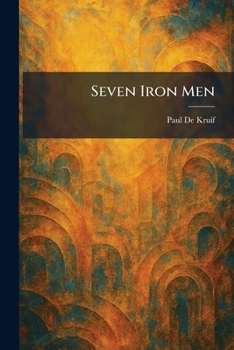
Seven Iron Men

"Seven Iron Men" is a gripping narrative that chronicles the epic saga of the Merritt family and their discovery of the legendary Mesabi Range in Minnesota. Written by acclaimed author Paul De Kruif, this work delves into the lives of the seven Merritt brothers and their kinsmen, whose indomitable spirit and physical endurance led them to uncover one of the richest deposits of iron ore in history. The story follows their transformation from rugged pioneers and timber cruisers into the architects of an industrial revolution that would eventually provide the raw materials for the American steel age.
Through vivid storytelling, De Kruif captures the essence of the frontier spirit, detailing the years of hardship, exploration, and eventual triumph over the harsh wilderness. However, the narrative is not merely one of discovery; it also serves as a poignant look at the complexities of high-stakes finance and the eventual loss of the Merritts' empire to more powerful industrial interests. "Seven Iron Men" remains a foundational text in the history of American industry, offering a dramatic and humanized account of the men who literally forged the backbone of a nation's infrastructure.
This work has been selected by scholars as being culturally important, and is part of the knowledge base of civilization as we know it. This work was reproduced from the original artifact, and remains as true to the original work as possible. Therefore, you may see the original copyright references, library stamps (as most of these works have been housed in our most important libraries around the world), and other notations in the work.
This work is in the public domain in the United States of America, and possibly other nations. Within the United States, you may freely copy and distribute this work, as no entity (individual or corporate) has a copyright on the body of the work.
As a reproduction of a historical artifact, this work may contain missing or blurred pages, poor pictures, errant marks, etc. Scholars believe, and we concur, that this work is important enough to be preserved, reproduced, and made generally available to the public. We appreciate your support of the preservation process, and thank you for being an important part of keeping this knowledge alive and relevant.
Related Subjects
Biographical Biographies Biographies & History Biography & History Engineering History TechnologyCustomer Reviews
ThriftBooks ® and the ThriftBooks ® logo are registered trademarks of Thrift Books Global, LLC
