The Chinese philosopher Mencius was one of the great thinkers in Confucian thought and develops many of the teachings of Confucius into a more mature form. If you're interested in Confucian thought, then you definitely need to read this volume. In addition to the main text of Mencius, this volume contains five valuable essays in the appendix. The first one covers the dating of events in Mencius. This is valuable for those who are interested in the historical aspects of Mencius. The second essay covers traditions and legends related to Mencius. The third essay covers the validity of the text of Mencius. The fourth essay covers Mencius' view of the history prior to his time. The final essay covers the practice of using analogy as a form of argument in the time of Mencius. These essays all add to a deeper understanding of the text. I recommend this particular volume of Mencius.
1
★★★★★
Mr. Mecius is super-fabulicius!!!
By Thriftbooks.com User, March 13, 2005
What can I say? This book is probably the closest Chinese book involving the art of parallel-argumentation that a person will ever get out of a Chinese book. I love this book. Plus, Lau really adds desert by his five highly detailed appendixes. Way to go Lau!
0
★★★★☆
Paralell Chinese/English text, Old Translation
By Thriftbooks.com User, January 19, 2002
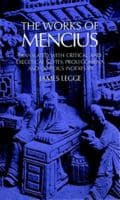
This book contains paralell Chinese and English text on every page of the Translated Work. It also contains some excerpts from thinkers who opposed Mencius's ideas. Mencius (Mang) was a proponent of Confucius's ideas of benevolent government, and travelled around "China"(the warring states) trying to convinceKings and princes to adopt his approach of generosity towards theruled, renunciation of offensive warfare, and respect for official rituals and rites. The Style of english translation in this book is considered to be archaic and off-putting by some, as it was done in the 1860's. It is very similar in presentation to Legge's Analects translation.
0
★★★★★
Discover a classic of Chinese literature!
By Thriftbooks.com User, January 19, 2001
Very few people in the West have heard of Mencius. However, in East Asia he is known as "the second sage" of Confucianism -- second only to Confucius himself. The eponymous _Mencius_ is a collection of his sayings and dialogues with disciples, rulers, and rival philosophers. It is unfortunate that this work is not more widely read outside of Asia. It is more accessible than the often cryptic _Analects_ of Confucius. Furthermore, Mencius is arguably a deeper philosophical thinker than Confucius. Buy this book and you'll get a fine translation of a classic of world literature and philosophy.Mencius is most famous for his claim that human nature is good. He illustrates this by asking us to imagine a person who suddenly sees a child about to fall into a well. Anyone, Mencius claims, would have a feeling of alarm and compassion at this sight. This feeling is a manifestation of our innate tendency toward benevolence. Mencius is aware that, despite having this innate tendency toward virtue, most people fail to act in a benevolent manner. But he claims that this is due to bad environmental factors, as well as a failure to cultivate one's "sprouts" of virtue. (Lau translates "sprout" as "germ," a minor infelicity.)Lau's _Mencius_ is probably the best complete translation of this work in English. It also includes extensive supporting material: an interpretive introduction, a glossary, and appendices on events in the life of Mencius, early traditions about Mencius, the text of the _Mencius_, ancient history as understood by Mencius, and Mencius's method of argumentation. James Legge also did a complete translation, _The Works of Mencius_, which is a little dated (it was completed in the late 19th century), but it is still a good translation, and includes the Chinese text, along with extensive notes. I did a partial translation of the _Mencius_ for _Readings in Classical Chinese Philosophy_.