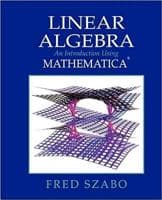
Linear Algebra: An Introduction With Mathematica uses a matrix-based presentation and covers the standard topics any mathematician will need to understand linear algebra while using Mathematica. Development of analytical and computational skills is emphasized, and worked examples provide step-by-step methods for solving basic problems using Mathematica. The subject's rich pertinence to problem solving across disciplines is illustrated with applications in engineering, the natural sciences, computer animation, and statistics. This description may be from another edition of this product.
Clear, theoretical yet practical, and thematic in nature
By Thriftbooks.com User, June 10, 2000
This is a modern interpretation of Linear Algebra that effectively uses Mathematica to illustrate concepts and bring them to life. At the same time, rigor and theory are not sacrificed in any way. In fact, detailed yet easy-to-read proofs are ubiquitous, and are almost always accompanied by examples using the software.The book comes full circle in the finale with an exposition of the SVD. In the process, it brings together concepts described throughout the book.In summary: As a working professional in computer imaging, I enjoy this book as my standard linear algebra text. It is a thematic book that really drives the point home, truly giving worth to the suggestion that the SVD should be called the fundamental theorem of linear algebra.